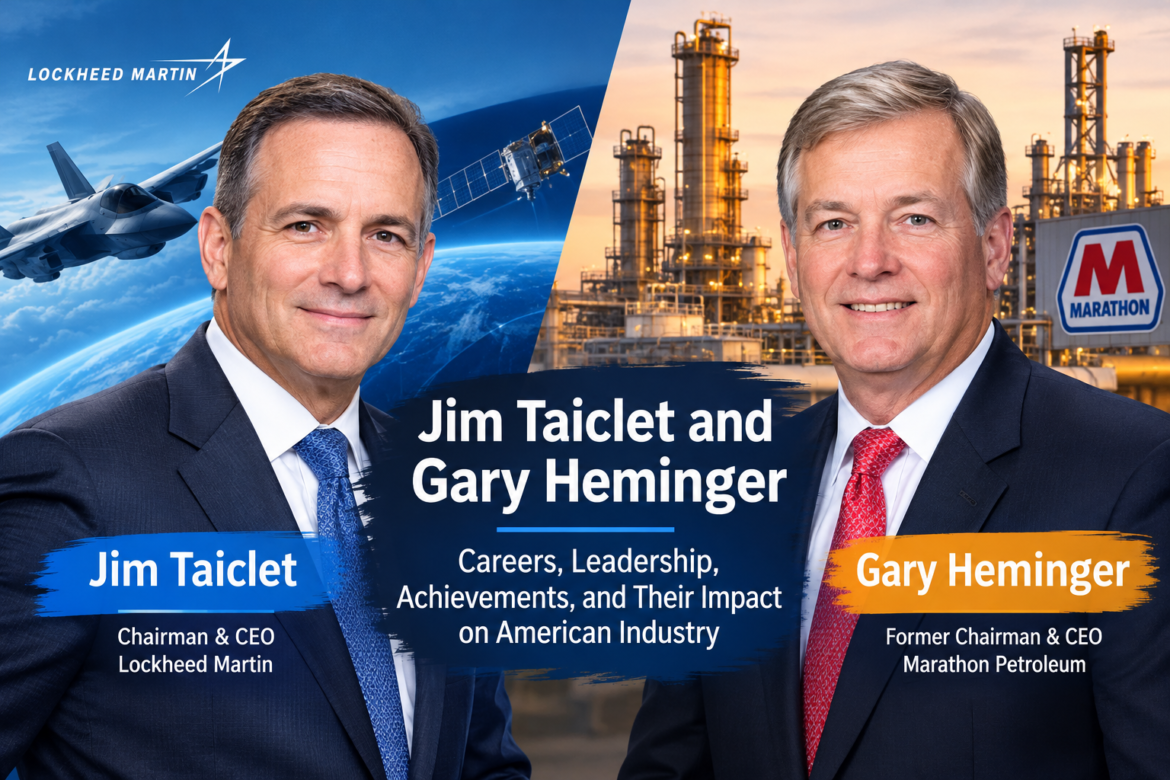
Introduction to Jim Taiclet and Gary Heminger
Jim Taiclet and Gary Heminger are two accomplished American business executives whose careers demonstrate different approaches to corporate leadership, strategic planning, and long-term growth. Jim Taiclet is known for his leadership in aerospace, defense technology, and telecommunications infrastructure, while Gary Heminger built his reputation through decades of experience in the petroleum and energy industry. Although their professional backgrounds differ, both have experience managing large organizations, making important business decisions, and navigating complicated industrial markets.
Their names are interesting to compare because they illustrate how executives can develop successful careers in very different sectors of the American economy. However, publicly available biographies do not establish a direct business partnership or family relationship between the two men, so their stories are best understood as separate leadership journeys rather than a shared personal history.
Who Is Jim Taiclet?
Jim Taiclet, whose full name is James D. Taiclet Jr., is a senior American business leader recognized for his work in aerospace, defense, and communications infrastructure. He became president and chief executive officer of Lockheed Martin in June 2020 and assumed the role of chairman in March 2021.
His professional background combines military experience with commercial management, making his career distinctive among major corporate executives. Before joining Lockheed Martin, he led American Tower Corporation, where he helped expand the business into an international communications infrastructure company. His experience also includes leadership positions at Pratt & Whitney and Honeywell’s aerospace services business.
Taiclet’s career reflects a combination of technical knowledge, organizational leadership, and strategic thinking. His work at Lockheed Martin places him at the center of an industry that supports national security, advanced aircraft development, missile defense, space technology, and other complex technological programs.
Jim Taiclet’s Early Life and Education
Jim Taiclet’s educational background helped establish the foundation for his later work in aviation and business. He graduated from the United States Air Force Academy, earning bachelor’s degrees in engineering and international relations. He later obtained a master’s degree in public affairs from Princeton University, where he received a fellowship at the institution’s public affairs school.
This combination of technical and policy-oriented education is relevant to understanding his career. Engineering provided a foundation for evaluating complicated systems, while international relations and public affairs offered insight into government institutions, global security, and the relationship between public policy and private industry. These areas of knowledge became particularly useful as his responsibilities expanded from military aviation to corporate management. Rather than following a purely commercial route into executive leadership, Taiclet developed experience across several fields, allowing him to approach major business challenges from both operational and strategic perspectives.
From Air Force Pilot to Corporate Executive
One of the most distinctive aspects of Jim Taiclet’s professional story is his early military career. He served as a United States Air Force officer and pilot, recording more than 5,000 flying hours, primarily in the Lockheed C-141B Starlifter transport aircraft. He also held aircraft command and instructor responsibilities and served in assignments connected with the Joint Staff and Air Staff at the Pentagon. During the Gulf War, he flew transport missions supporting Operation Desert Shield.
These experiences exposed him to environments where preparation, technical reliability, teamwork, and sound judgment were essential. Military aviation requires careful planning and the ability to respond effectively when circumstances change, qualities that can also prove valuable in corporate leadership. His later appointment to lead Lockheed Martin brought his career back into contact with an organization whose aircraft he had flown during his military service. That connection between operational experience and executive responsibility is an important part of his public professional story.
Jim Taiclet’s Career at American Tower
Before becoming the leader of Lockheed Martin, Taiclet spent many years in the telecommunications infrastructure industry. He joined American Tower Corporation in 2001 and became its chief executive officer in 2003, later serving as chairman. Under his leadership, the company developed from a primarily United States-focused business into a major international operator of communications infrastructure. Lockheed Martin and NASA biographies describe American Tower’s market capitalization growing from approximately $2 billion to around $100 billion during his tenure, while the company expanded its international presence across 19 countries.
This growth is frequently highlighted as a major achievement in his career because telecommunications infrastructure plays an essential role in mobile communications, digital connectivity, and the broader technology economy. Leading such an organization required attention to investment, infrastructure development, business operations, and changing customer needs. The experience also gave Taiclet a foundation in managing large-scale technological assets, which became relevant when he moved into the aerospace and defense sector.
Jim Taiclet’s Leadership at Lockheed Martin
Lockheed Martin is one of the world’s leading aerospace and defense companies, with operations involving advanced aircraft, missile systems, space technologies, and other defense-related products. Taiclet joined the company as president and CEO in June 2020 after serving on its board of directors since 2018. He became chairman in March 2021. The company’s leadership strategy under him has emphasized technological innovation, digital integration, autonomy, and the resilience of defense supply chains.
These priorities reflect the changing nature of national security, where traditional military platforms increasingly depend on software, digital systems, communications networks, and sophisticated manufacturing capabilities. Managing a defense contractor also requires coordination with government customers, international partners, suppliers, engineers, and thousands of employees. Taiclet’s responsibility therefore extends beyond financial performance to include the delivery of complex products, the management of industrial capacity, and the company’s ability to meet long-term commitments. His career illustrates how a leader with experience in both military operations and commercial infrastructure can bring a broad perspective to the defense industry.
Who Is Gary Heminger?
Gary R. Heminger is an American business executive best known for his long career at Marathon Petroleum Corporation. He joined Marathon in 1975 and spent more than four decades working across finance, auditing, marketing, business development, transportation, and refining-related operations. He became president and CEO of Marathon Petroleum Corporation in July 2011 and chairman of its board in 2016. He retired from the company in 2020 after approximately 45 years of service.
Heminger’s career differs from Taiclet’s because it developed largely within one industrial organization rather than across several unrelated sectors. His rise through different departments gave him extensive knowledge of the petroleum business, from commercial activities to the operational demands of a large energy company. His leadership period also involved major organizational changes, including the integration of Andeavor following its combination with Marathon Petroleum.
Gary Heminger’s Education and Early Career
Heminger earned a bachelor’s degree in accounting from Tiffin University in 1976 while already working for Marathon Oil Company. He later completed a Master of Business Administration degree at the University of Dayton in 1982 and attended the Wharton School’s Advanced Management Program at the University of Pennsylvania.
His accounting education provided a useful foundation for understanding financial statements, business controls, budgets, and the economic considerations involved in operating a large industrial enterprise. However, his career was not limited to financial management. Over time, he took on assignments involving auditing, marketing, pipeline operations, and business development.
He also served as president of Marathon Pipe Line Company during the 1990s and subsequently held senior positions in Marathon’s downstream operations. These varied responsibilities allowed him to understand how different parts of the energy business interact. His progression demonstrates the value of gaining experience across an organization, particularly in industries where production, transportation, refining, distribution, and sales are closely connected.
Gary Heminger’s Leadership at Marathon Petroleum
Heminger became president and CEO of Marathon Petroleum Corporation in 2011, the year the company was established as a separate publicly traded business following its separation from Marathon Oil. He became chairman in 2016 and continued to oversee the organization until his retirement in 2020.
During this period, Marathon Petroleum operated across several connected areas of the energy business, including petroleum refining, marketing, retail, and transportation infrastructure. Leading such a company required balancing operational efficiency with changing fuel demand, commodity prices, environmental requirements, safety standards, and the financial expectations of shareholders.
Heminger’s long experience within Marathon meant that he understood the company’s internal structure and the relationships between its business units. His leadership also included a significant acquisition-related challenge: helping integrate Andeavor into Marathon Petroleum. Large combinations can create opportunities for scale and broader operations, but they also require careful coordination of employees, assets, systems, and business priorities. Jim Taiclet and Gary Heminger tenure is therefore associated with an important period of organizational development for the company.
The Importance of Marathon Petroleum in the Energy Industry
Marathon Petroleum plays a significant role in the American energy market through its refining and related operations. Refining involves converting crude oil into products such as gasoline, diesel, and other petroleum-based materials used across transportation, manufacturing, and everyday life. The industry depends on extensive infrastructure, including refineries, pipelines, storage facilities, distribution networks, and retail channels. Heminger’s experience across these areas helped prepare him for the responsibilities of leading the company.
His earlier positions in marketing, supply, transportation, and business development provided practical knowledge of how energy products move through the commercial system. His role also required attention to the financial and regulatory challenges that affect petroleum businesses. Energy companies operate in markets influenced by global oil prices, consumer demand, geopolitical developments, and evolving environmental policies. For an executive, success in this environment depends on understanding both immediate operating conditions and long-term changes in the energy sector.
Jim Taiclet and Gary Heminger: A Comparison of Leadership Styles
Although Jim Taiclet and Gary Heminger worked in different industries, their careers offer several useful points of comparison. Taiclet’s professional path crossed military aviation, aerospace services, telecommunications infrastructure, and defense technology. Heminger’s career developed mainly within Marathon’s energy operations, where he gained experience in finance, marketing, transportation, and refining.
Taiclet’s background illustrates the advantages of combining experience across multiple industries, particularly when businesses must adapt to technological change. Jim Taiclet and Gary Heminger career demonstrates the benefits of deep institutional knowledge and steady progression through different functions within a single organization. Neither approach is automatically superior.
The effectiveness of a leadership style depends on the business environment, the organization’s goals, and the challenges confronting its management team. A technology-focused defense company and a petroleum refining business face different operating requirements, investment cycles, and regulatory pressures. Their careers therefore provide contrasting examples of how executive experience can develop in response to distinct industrial needs.
What Their Careers Reveal About Strategic Decision-Making
Strategic decision-making is an essential part of leading any large company, but the decisions executives face depend heavily on the industry. For Taiclet, strategic priorities include technological development, industrial capacity, supply-chain reliability, and the ability to deliver sophisticated defense systems. For Jim Taiclet and Gary Heminger, major leadership responsibilities involved refining operations, energy logistics, commercial performance, and the integration of large business operations.
Both environments demand decisions that may take years to produce their full results. Investments in manufacturing, infrastructure, research, and equipment can require substantial resources before their benefits become visible. Leaders must also consider risks that cannot be eliminated entirely, including changes in demand, regulatory decisions, international developments, and operational disruptions. Their careers suggest that effective strategy requires more than setting ambitious goals. It also requires understanding the organization’s capabilities, managing competing priorities, communicating expectations, and adjusting plans when conditions change.
Their Contributions Beyond Executive Positions
Both men have had professional responsibilities beyond their primary executive roles. Taiclet’s public biography lists involvement with organizations such as the Council on Foreign Relations and Mass General Brigham, reflecting interests that extend into international affairs and institutional governance.
Heminger has also served in governance and industry-related roles. His documented affiliations have included PPG Industries, Fifth Third Bancorp, industry associations, and educational institutions. He was elected to the board of PPG Industries in 2017, bringing experience in industrial management, finance, marketing, and operations.
Such responsibilities are common among experienced corporate leaders because boards and professional organizations benefit from people who understand risk, strategy, financial oversight, and organizational management. These roles also show that executive influence can continue through governance and advisory responsibilities, even when an individual is no longer managing a company on a full-time basis.
Are Jim Taiclet and Gary Heminger Connected?
A central question surrounding the keyword “Jim Taiclet and Gary Heminger” is whether the two executives share a documented personal or professional connection. Their publicly available biographies establish their respective leadership histories, but they do not establish that the men founded a company together, held a joint executive position, or maintained a direct business partnership. Taiclet’s career is principally associated with Lockheed Martin, American Tower, and earlier aerospace organizations, while Heminger’s career is principally associated with Marathon Petroleum and other corporate and industry governance roles.
It would therefore be misleading to describe them as business partners or to suggest a personal relationship without reliable evidence. The fact that two executives are prominent in American industry does not necessarily mean they have worked together directly. A more accurate way to discuss them is to compare their achievements, leadership experiences, and influence within their respective sectors. This distinction is important for readers seeking dependable information rather than speculation.
Lessons for Aspiring Business Leaders
The professional journeys of Jim Taiclet and Gary Heminger offer several lessons for people interested in business management. First, broad experience can help leaders understand complicated organizations. Taiclet’s military and corporate background gave him exposure to different operating environments, while Heminger’s progression through numerous functions gave him detailed knowledge of the petroleum business. Second, education can provide a useful foundation, but professional development also depends on practical responsibility and continuous learning.
Third, major organizations require leaders who can balance immediate performance with long-term investment. Whether a company develops advanced defense systems or processes energy products, management must consider safety, reliability, financial discipline, customer requirements, and future demand. Finally, leadership is rarely the work of one individual alone. Executives rely on technical specialists, employees, suppliers, boards, and other stakeholders to achieve organizational goals. Their careers highlight different routes to senior leadership and show why judgment, adaptability, and a strong understanding of an organization’s core business remain valuable.
Conclusion: Understanding Jim Taiclet and Gary Heminger
Jim Taiclet and Gary Heminger represent two distinct examples of executive leadership in American industry. Taiclet’s career spans military aviation, telecommunications infrastructure, aerospace services, and defense technology, culminating in his leadership of Lockheed Martin. Heminger spent approximately 45 years at Marathon, rising through finance, marketing, transportation, business development, and senior management before retiring as chairman and CEO in 2020.
Their professional experiences differ, but both illustrate the importance of industry knowledge, strategic planning, operational discipline, and the ability to lead large organizations through change. Available evidence supports comparing their careers, not claiming an unverified relationship between them. For readers researching Jim Taiclet and Gary Heminger, understanding each man’s background separately provides the clearest picture of their achievements and their respective contributions to the defense and energy sectors.
You Many Also Read: Abraham Quiros Villalba



1 thought on “Jim Taiclet and Gary Heminger in 2026: Careers, Leadership, Achievements, and Their Impact on American Industry”