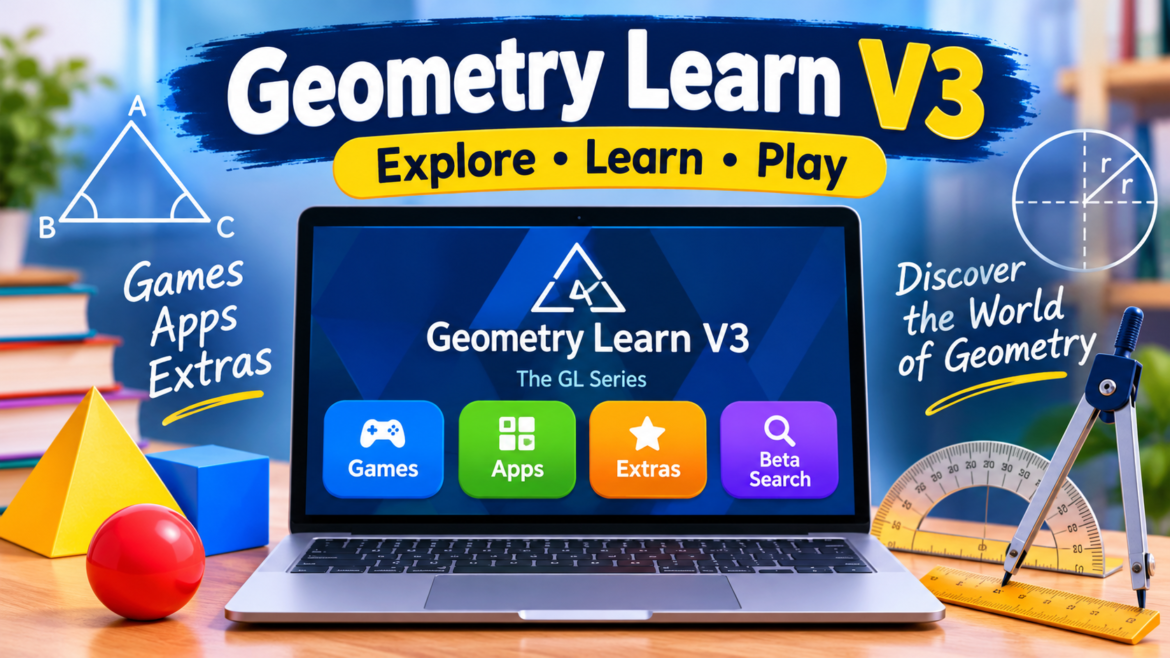
What Is Geometry Learn V3?
Geometry Learn V3 is a browser-based online project associated with the GL Series that has attracted attention from people searching for digital activities, online games, applications, and geometry-related resources. Its name may initially suggest a dedicated mathematics education platform, but the publicly visible project offers a broader online experience. The interface identifies itself as V3 and The GL Series, with sections such as Games, Apps, Extras, and a beta search feature.
This makes Geometry Learn V3 an interesting subject for students, casual internet users, and people exploring browser-based platforms. One important detail is that the name alone does not establish that the website provides a complete geometry curriculum or accredited mathematics instruction. Some online descriptions associate it with learning shapes, angles, measurements, and spatial reasoning, while the publicly visible interface presents a wider collection of digital resources.
Understanding this difference helps visitors develop realistic expectations before exploring the project. Geometry Learn V3 is best approached as an independent browser-based resource whose individual features should be examined rather than assuming that every advertised educational benefit is officially documented.
Understanding the Meaning Behind Geometry Learn V3
The name Geometry Learn V3 contains three recognizable elements that help explain why people search for it. Geometry refers to the mathematical study of shapes, lines, angles, measurements, and spatial relationships. Learn suggests an educational or informational purpose, while V3 commonly represents version three of a software project or digital product. Together, these words create the impression of a modern online learning resource.
However, the actual identity of a website should be determined by its available features and documentation rather than its name alone. The publicly visible project connects the V3 designation with the GL Series, but there is limited reliable information explaining its complete development history or the exact differences between earlier versions. This means visitors should avoid assuming that V3 represents a professionally developed educational system with advanced artificial intelligence, personalized lessons, or officially recognized academic content.
Instead, it is more reasonable to understand Geometry Learn V3 as a browser-based project that brings together different online resources. Its combination of a mathematics-related name and general digital features makes it particularly interesting to people discovering unfamiliar websites through search engines.
The Main Features of Geometry Learn V3
One reason Geometry Learn V3 attracts attention is its collection-style interface. Rather than presenting itself like a conventional textbook website, the publicly visible project provides navigation to different sections. Games, Apps, Extras, and Beta Search are among the identifiable elements associated with the GL Series. These sections suggest an environment designed to help visitors explore different browser-based resources. The Games section is particularly relevant to people interested in casual online entertainment, while the Apps section suggests access to additional digital tools.
Extras provides another area for exploring available resources, although the exact contents may depend on the current version of the website. Beta Search is another recognizable feature that indicates an experimental search function. It is important to distinguish these visible interface elements from claims about advanced educational capabilities because not every feature described by third-party websites can be independently verified. A responsible visitor should explore each section carefully, understand what it offers, and decide whether it supports their particular purpose. The website’s features and availability may also change as its developers update the project.
How Geometry Learn V3 Relates to Mathematics Education
Although Geometry Learn V3 is not established as a complete mathematics curriculum, its name naturally connects it with an important area of education. Geometry helps students understand the physical and visual world through mathematical relationships. It introduces concepts such as points, lines, angles, triangles, circles, polygons, area, perimeter, and volume. These subjects appear in classrooms, engineering projects, architecture, computer graphics, and everyday problem-solving.
Digital resources can make these topics easier to explore when they include accurate diagrams, interactive examples, and meaningful exercises. For example, a student studying triangles may benefit from changing the dimensions of a diagram and observing how its angles and sides relate to one another. Similarly, visual demonstrations can help explain why the area of a rectangle changes when its length or width changes.
However, these are examples of useful geometry-learning activities, not verified claims about specific features currently offered by Geometry Learn V3. Anyone interested in using the project for mathematics should first confirm whether the particular resource they access actually includes educational material. This distinction ensures that learners do not confuse an entertaining browser activity with structured academic instruction.
Why Interactive Digital Resources Attract Students
Modern students increasingly use websites, applications, videos, and browser-based activities to explore subjects outside traditional classrooms. Interactive digital resources can make learning more engaging because they encourage users to participate instead of simply reading information. Geometry is especially suitable for visual explanations because many of its principles involve shapes, positions, measurements, and spatial relationships.
A well-designed geometry activity can allow learners to experiment with different measurements and immediately observe the results. This type of experience may help students develop curiosity and improve their understanding of mathematical ideas. Browser-based platforms are also convenient because they can often be accessed without installing complicated software. However, convenience does not automatically mean that a resource is academically reliable.
Students should look for correct mathematical explanations, clear instructions, suitable exercises, and accurate answers. Geometry Learn V3 may interest people exploring this category of digital resources, but the actual educational value depends on the content available through the specific website or activity. Combining digital exploration with classroom instruction, textbooks, and regular practice remains a more dependable approach to learning mathematics.
Exploring the Games Section
The Games section is one of the publicly visible navigation categories associated with Geometry Learn V3. Browser games are popular because they offer quick entertainment without necessarily requiring users to install additional applications. Depending on the available collection, visitors may discover different types of casual activities, puzzles, and interactive experiences. These activities can appeal to people looking for something enjoyable during a break or while exploring a new website.
Some games also involve problem-solving, pattern recognition, logical thinking, and decision-making, which can provide additional mental stimulation. Nevertheless, it is important not to assume that every game is designed to teach geometry or improve mathematical performance. Entertainment and education are different purposes, even though certain activities can combine both.
Visitors should examine the instructions and objectives of individual games before deciding whether they are useful for learning. Another important consideration is the website’s current content because browser-based projects can add, remove, or reorganize activities over time. The Games section therefore represents an interesting part of the project’s identity, but its precise educational value should be judged by the activities themselves.
Understanding the Apps Section
The Apps section is another feature associated with the Geometry Learn V3 interface. In general, browser-based applications can provide convenient access to small digital tools without requiring traditional desktop installations. Depending on the project, these applications may support different activities, utilities, or forms of online interaction. Their usefulness depends on their design, functionality, reliability, and purpose.
For students, a genuinely educational application might provide a calculator, measurement tool, diagram viewer, or practice activity. For general visitors, an application could offer an entirely different experience. However, the publicly visible interface does not establish that every application associated with Geometry Learn V3 is specifically designed for mathematics. Visitors should therefore check the description and functionality of each tool instead of relying entirely on the website’s name.
It is also sensible to avoid applications that request unnecessary permissions, personal information, or unfamiliar downloads. A trustworthy digital experience should explain what a tool does and provide reasonable information about how users interact with it. Examining these details can help visitors decide whether the Apps section provides something genuinely useful.
What Is the Purpose of Beta Search?
Beta Search is another recognizable element associated with the Geometry Learn V3 project. The term beta generally refers to an experimental or testing stage of software development. Developers often use beta versions to introduce features while continuing to identify technical problems, collect feedback, and improve performance. A beta search function may provide a way to explore information or navigate available resources, depending on how it has been implemented.
However, users should not automatically assume that an experimental search feature provides the same accuracy, speed, or reliability as a mature search engine. Search results should be checked carefully, especially when visitors are looking for educational information or unfamiliar websites. The presence of a beta label is useful because it communicates that a feature may still be under development.
If the search experience produces unexpected results or does not respond correctly, users should avoid entering sensitive information or relying on unverified links. Understanding the meaning of beta functionality helps visitors approach experimental tools with realistic expectations while recognizing that software features can change during development.
How to Approach Geometry Learn V3 as a New Visitor
People discovering Geometry Learn V3 for the first time should begin by examining the website’s visible structure. Checking the main navigation provides an overview of the available sections and helps visitors understand whether the project matches their interests. The Games, Apps, and Extras categories can be explored individually, while the search feature may provide another way to discover available resources. It is sensible to read any instructions presented before opening an activity. Visitors should also confirm that they are using the intended website rather than an unrelated copy with a similar name.
This matters because unfamiliar websites can sometimes use popular keywords to attract visitors without providing the features people expect. Checking the domain, browser security indicators, and available site information can reduce confusion. Users should avoid downloading unknown files or providing personal information unless there is a clear and trustworthy reason. If a particular activity does not work, refreshing the page or trying another browser may help, but visitors should not disable important security protections to access it. A careful approach makes exploring unfamiliar online projects more comfortable and responsible.
Can Geometry Learn V3 Help Students Improve Their Skills?
The answer depends on which activities are available and whether they provide meaningful learning opportunities. Students improve mathematical skills through regular practice, accurate explanations, feedback, and a gradual understanding of increasingly difficult concepts. A digital resource can support this process when it provides appropriate educational material. For example, a student learning about angles benefits from understanding the difference between acute, right, obtuse, and straight angles.
Someone studying triangles needs to recognize different classifications and understand basic angle relationships. Learners exploring circles should become familiar with radius, diameter, circumference, and area. These subjects require more than simply recognizing pictures; students must understand the rules and apply them to mathematical problems.
If a Geometry Learn V3 activity genuinely supports these learning goals, it may provide supplementary practice. However, there is insufficient verified information to claim that the project offers a complete teaching sequence, automated assessment system, or personalized mathematics program. Students should use established educational materials for important school assignments and examinations, treating unfamiliar digital resources as optional additions rather than guaranteed replacements.
Geometry Learn V3 and the Importance of Visual Learning
Visual learning is particularly valuable in geometry because mathematical relationships are often easier to understand when represented through diagrams. A written explanation of a triangle’s angles may seem complicated to a beginner, but a correctly labeled diagram can make the relationship more understandable. Similarly, visual representations of circles, rectangles, squares, and polygons help students recognize their properties. Digital tools can make these demonstrations more flexible by allowing learners to examine different shapes and measurements.
For instance, changing the dimensions of a rectangle can demonstrate how its area and perimeter respond to different measurements. Three-dimensional representations can also help explain volume, surface area, and spatial relationships. These examples demonstrate the educational potential of interactive geometry resources generally. They should not be interpreted as confirmation that every one of these tools is available within Geometry Learn V3. The most effective approach is to evaluate the actual activity and determine whether it explains a concept accurately. Visual demonstrations become especially useful when combined with written notes, worked examples, and independent problem-solving.
Is Geometry Learn V3 Free to Use?
Questions about cost are common when people discover an unfamiliar browser-based platform. Visitors generally want to know whether they can explore its features without paying for a subscription or creating an account. The publicly visible Geometry Learn V3 project is accessible as a browser-based website, but that alone does not establish the pricing arrangements of every linked resource, game, or application. Individual third-party services may have their own requirements, advertisements, payment options, or account policies.
For this reason, users should check the terms presented by the specific resource they intend to use. They should be cautious about websites that request payment unexpectedly or advertise premium features without clearly explaining what is included. A free-access page does not necessarily mean that every external tool linked from it is free. Checking the relevant information before signing up or purchasing anything can prevent misunderstandings. Students and parents should also remember that many established educational websites offer free mathematics lessons, practice questions, and instructional videos, making it possible to compare resources before choosing one.
Is Geometry Learn V3 Safe for Students?
Online safety should be an important consideration whenever students explore unfamiliar websites. Geometry Learn V3, like other independent browser projects, should be evaluated according to its actual domain, content, external links, and privacy practices. A website’s name or appearance cannot guarantee that every linked page is suitable for younger visitors. Parents and teachers should check the website before recommending it to students, especially when it includes third-party applications or games. Visitors should avoid sharing passwords, personal addresses, financial details, or other sensitive information with unfamiliar services.
They should also be careful with unexpected downloads, browser notifications, and permission requests. Keeping browsers updated and using reputable security tools can provide additional protection. School environments may also have specific internet policies, so students should follow the rules established by their teachers and administrators. If an activity displays suspicious advertisements or redirects visitors to unrelated websites, leaving the page is a sensible choice. Responsible browsing does not mean avoiding every new website; it means evaluating digital resources before trusting them.
Advantages of Exploring Browser-Based Resources
Browser-based resources offer several practical advantages that explain their popularity. First, accessibility is often straightforward because visitors can open a website through an internet browser rather than installing a large software package. Second, different resources can be explored from a single interface, potentially reducing the effort required to move between websites. Third, online activities can provide variety, which may appeal to people who enjoy discovering different forms of entertainment or digital tools.
Another advantage is flexibility because users can explore available resources at their own pace. Students may also benefit from digital activities that complement subjects they are already studying. However, these general advantages should not be confused with verified performance claims about Geometry Learn V3. The quality of any browser-based project depends on its actual content, maintenance, usability, and reliability. Internet connectivity may also affect the experience, and some external resources may not work equally well on every device. Evaluating these practical details helps users determine whether a particular platform deserves a place in their regular online activities.
Limitations Users Should Understand
Every online resource has limitations, and Geometry Learn V3 should be approached with realistic expectations. One important limitation is the lack of clearly established public documentation describing a complete geometry curriculum. Although some third-party websites associate the name with educational activities, the publicly visible project does not provide enough evidence to confirm every claim. Information about accreditation, formal assessments, teacher support, grade-level alignment, and structured learning objectives is also not clearly established.
This means students should not depend on it as their only source of mathematics instruction. Another consideration is that browser-based projects can change over time, meaning that features available during one visit may not remain identical during another. External links can also introduce differences in quality, safety, and accessibility. Visitors should therefore judge each resource independently rather than assuming that every section follows the same standards. Understanding these limitations does not mean the project has no value. It simply encourages people to make informed decisions based on verified information rather than exaggerated expectations.
Geometry Learn V3 Compared With Traditional Learning Resources
Traditional geometry education generally follows a structured approach. Students learn foundational definitions before progressing toward more advanced concepts, practice calculations, study diagrams, and complete assessments to demonstrate understanding. A textbook or established online mathematics course usually explains its curriculum and provides a sequence of lessons.
Browser-based projects may offer a different experience, focusing on exploration, games, applications, or individual activities. Neither format automatically replaces the other. A well-designed educational website can complement traditional instruction by offering additional examples and opportunities to practise. At the same time, casual digital activities may provide entertainment without developing a complete understanding of mathematical concepts.
Geometry Learn V3 should be evaluated within this distinction. Its publicly visible interface is associated with a broader browser-based environment, and its educational status should not be assumed. Students preparing for examinations should follow the requirements of their school curriculum and use trusted instructional materials. Exploring additional websites can be helpful, but the quality of the actual lessons and exercises should determine whether those resources deserve regular use.
Who May Be Interested in Geometry Learn V3?
Geometry Learn V3 may attract several types of internet users for different reasons. Students may discover the name while searching for geometry-related websites or browser activities. Casual visitors may be more interested in its Games and Apps sections. People researching online platforms may want to understand the meaning of V3 and the project’s connection with the GL Series. Parents and teachers may also investigate the website before deciding whether it is suitable for students. Technology enthusiasts might be interested in exploring its interface, navigation, and beta search functionality.
However, these different audiences should approach the project according to their individual needs. Someone looking for entertainment may evaluate the available games, while a student seeking mathematics instruction should focus on whether genuine educational content is provided. A parent may prioritize privacy, security, and age suitability. Recognizing these different expectations makes it easier to understand why the same website can attract interest from people with very different goals.
The Future Potential of Online Geometry Resources
Digital education continues to develop as technology makes interactive learning experiences more accessible. Websites and applications can support mathematical instruction through diagrams, simulations, quizzes, videos, and practice exercises. In geometry, these tools can help learners explore shapes and understand relationships that may otherwise seem abstract. Future platforms may also provide better accessibility features, improved mobile experiences, and more flexible ways to practise mathematical concepts.
However, successful educational technology requires more than an attractive interface. Accurate content, understandable explanations, useful feedback, and appropriate learning objectives are essential. Independent projects can improve their usefulness by providing clear descriptions of their purpose, maintaining reliable features, and explaining what visitors can expect.
Geometry Learn V3 belongs to a broader conversation about browser-based digital resources, but its future development and educational capabilities should be judged through observable updates rather than assumptions. As users become more careful about verifying online information, transparent documentation will remain an important factor in building trust.
Final Thoughts on Geometry Learn V3
Geometry Learn V3 is an interesting search term associated with a browser-based project known as part of the GL Series. Its publicly visible interface includes Games, Apps, Extras, and Beta Search, creating a broader digital experience than the name might initially suggest. Although some online descriptions connect it with geometry education, the available public evidence does not establish it as an accredited or comprehensive mathematics-learning platform. Visitors should therefore explore its actual features, check external links, and avoid assuming that every advertised educational benefit is verified.
Students looking to improve their geometry knowledge should continue using structured lessons, trusted textbooks, and regular mathematical practice. Browser-based resources can provide additional opportunities for exploration when their content is relevant and reliable. Ultimately, the best way to understand Geometry Learn V3 is to look beyond its name and examine what the project genuinely offers. This approach allows students, parents, and general internet users to make informed decisions while discovering the possibilities and limitations of modern online resources.
Frequently Asked Questions About Geometry Learn V3
What is Geometry Learn V3? Geometry Learn V3 is a browser-based project associated with the GL Series. Its publicly visible interface includes Games, Apps, Extras, and a beta search feature.
Is Geometry Learn V3 a mathematics learning platform? Its name suggests a connection with mathematics education, and some third-party descriptions present it as a learning resource. However, a complete or accredited geometry curriculum has not been verified.
What does V3 mean? V3 appears to be a version designation used by the project. A detailed and independently verified development history is not publicly established.
Does Geometry Learn V3 include games? Yes, Games is one of the sections displayed in its publicly visible interface.
Can students use Geometry Learn V3? Students can investigate its available activities, but they should check the content and follow school internet policies. It should not replace established mathematics instruction.
Is Geometry Learn V3 free? The publicly accessible project can be visited through a browser, but the pricing and requirements of individual external resources may differ.
Is Geometry Learn V3 safe? Users should evaluate its domain, external links, privacy practices, and downloads before interacting with unfamiliar resources.
Can Geometry Learn V3 replace traditional geometry lessons? There is insufficient evidence to recommend it as a replacement for structured geometry lessons, textbooks, or teacher-led instruction.
You Many Also Read: Heidi Regina
1 thought on “Geometry Learn V3: Understanding Its Features, Uses, Online Experience, and What Users Should Know”