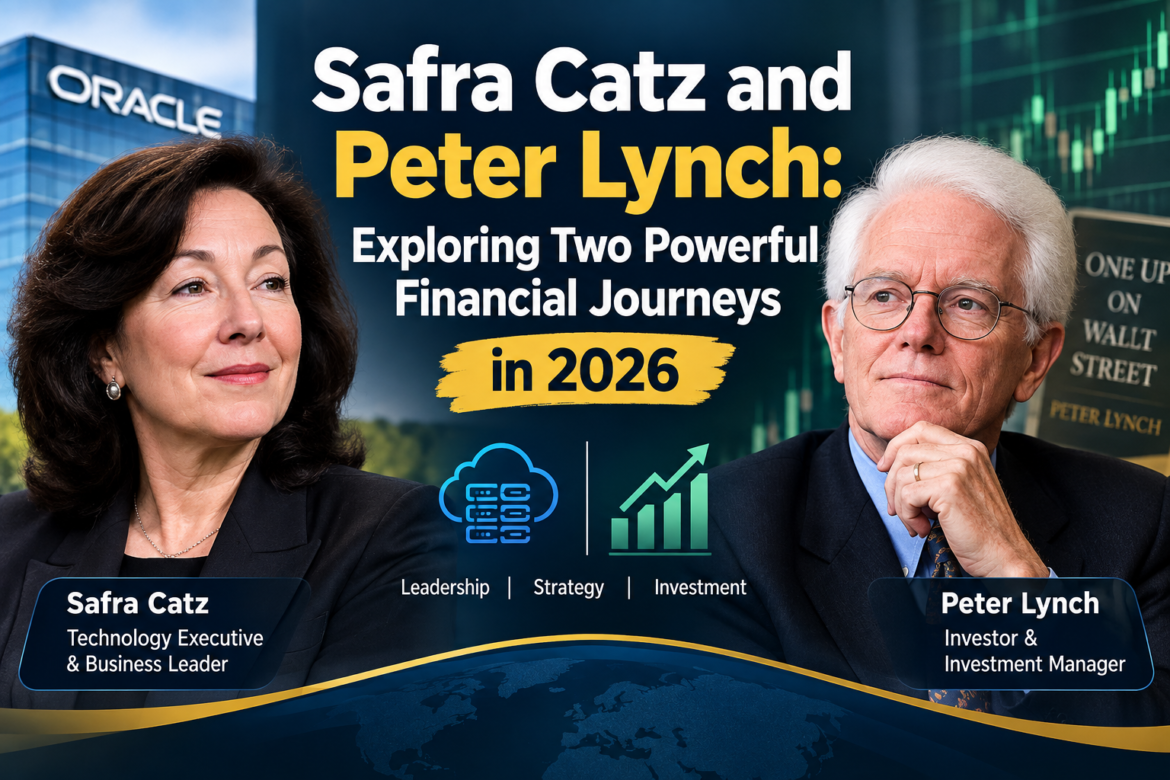
Safra Catz and Peter Lynch: Two Different Paths to Business and Financial Success
Safra Catz and Peter Lynch are two well-known names associated with business, finance, leadership, and long-term thinking, although their professional careers developed in very different directions. Safra Catz became a prominent technology executive through her long career at Oracle, where she held senior financial and leadership positions before serving as chief executive officer. Peter Lynch became widely recognized as an investor and former manager of Fidelity Magellan, where his approach to researching companies and understanding their business stories influenced generations of investors.
Looking at Safra Catz and Peter Lynch together provides an interesting way to explore two different sides of the modern business world: corporate leadership and investment analysis. Their careers demonstrate how financial knowledge, disciplined decision-making, business understanding, and attention to long-term results can play important roles in professional success.
Who Is Safra Catz?
Safra Catz is a major figure in the technology and corporate finance world. She built her career at Oracle after previously working in investment banking at Donaldson, Lufkin & Jenrette. At Oracle, she served in several senior roles, including executive vice president, president, and chief financial officer. Oracle’s official biography currently identifies her as executive vice chair of the company’s board of directors. Her career is particularly notable because it combines financial expertise with high-level technology management. Rather than becoming known primarily as an investor analyzing companies from the outside, Catz developed her reputation by helping lead a large technology company from within.
Catz’s professional background illustrates how financial skills can become powerful tools for corporate leadership. A chief financial officer, for example, is expected to understand financial statements, capital allocation, budgets, investments, costs, and business performance while also working with other executives on strategic decisions. Catz’s career at Oracle expanded beyond finance into broader executive responsibilities. She eventually became CEO in 2014 and held that role for more than a decade. In September 2025, Oracle announced that Clay Magouyrk and Mike Sicilia would become CEOs and that Catz would become executive vice chair of the board.
Who Is Peter Lynch?
Peter Lynch is best known for his work as an investor and for his leadership of Fidelity Magellan. His investment philosophy became associated with researching individual businesses, understanding their growth opportunities, examining financial fundamentals, and paying attention to valuation. Fidelity continues to reference Lynch’s investing ideas in educational material, including the concept commonly summarized as “buy what you know.” The basic idea is that everyday experience can sometimes help investors identify businesses or products that deserve further research, although recognizing a familiar product is only a starting point rather than sufficient evidence for an investment decision.
Lynch’s approach emphasized research rather than simply buying a company because it was popular. Fidelity materials discussing his ideas describe his interest in earnings growth, valuation, debt, inventories, cash, and the overall financial condition of a business. He also encouraged investors to understand the underlying story of a company before committing capital. This approach helped make his investment philosophy accessible to people who might otherwise view professional investing as a complicated or mysterious activity.
Safra Catz and Peter Lynch Come From Different Professional Worlds
The most important distinction between Safra Catz and Peter Lynch is the position from which each approached business. Catz worked primarily as a corporate executive. Her responsibilities involved helping operate and guide a major technology organization. Lynch, by contrast, approached businesses primarily as an investor deciding where capital should be allocated. One operated inside a corporation, while the other evaluated corporations from the perspective of an investment manager. This difference makes their careers useful for comparison because it highlights two complementary perspectives on business performance.
A corporate executive has to think about employees, customers, products, competition, technology, revenue, costs, acquisitions, shareholders, and long-term corporate strategy. An investment manager has to decide whether a company’s business prospects and valuation justify investing clients’ capital. Although the responsibilities are different, both perspectives require a strong understanding of how businesses actually work. A company can have impressive technology but weak financial performance, or it can have strong financial results but face long-term competitive challenges. Understanding those distinctions is central to both corporate leadership and investment research.
The Importance of Financial Knowledge
Financial knowledge is one of the clearest connections between the careers of Safra Catz and Peter Lynch. Catz’s professional background includes investment banking and senior finance positions at Oracle, while Lynch’s investment philosophy emphasizes financial analysis as an important part of researching stocks. Oracle’s biography notes that Catz worked as a managing director in investment banking before joining Oracle. Her later career demonstrates how financial expertise can be applied to corporate decision-making at a large technology company.
Lynch’s educational material similarly emphasizes examining company financials before making an investment decision. Fidelity’s published materials discussing Lynch’s ideas mention measures such as earnings growth, the price-to-earnings ratio relative to growth, inventory growth, debt-to-equity levels, and cash resources. These concepts show why financial statements matter: they can provide evidence about whether a company’s apparent growth is supported by underlying business performance.
Safra Catz and Corporate Transformation
One of the important themes associated with Safra Catz’s Oracle career is corporate transformation. Oracle has spent years adapting its business from its traditional database-centered model toward cloud infrastructure, cloud applications, and newer technologies. In a 2020 Oracle discussion, Catz described digital transformation as involving not only technology but also changes in how organizations operate. Her comments emphasized that transformation can require people and organizations to rethink established processes rather than simply installing new software.
This perspective is significant because large companies cannot remain successful simply by repeating the same business model forever. Technology changes, customer expectations change, competitors develop new products, and business models evolve. Corporate leaders therefore have to consider when existing operations need to change and how resources should be allocated toward new opportunities. Catz’s career at Oracle provides an example of how financial and operational leadership can intersect during a period of major technological change.
Peter Lynch and Understanding the Business Story
Peter Lynch’s investment philosophy placed considerable emphasis on understanding the actual business behind a stock symbol. Fidelity’s published material describing his approach says investors should understand why they own a company and should examine its financials before investing. This philosophy encourages people to move beyond short-term price movements and consider questions about products, customers, earnings, debt, growth, and competition.
The business story concept is useful because stock prices can sometimes distract investors from the underlying company. A share price may rise or fall dramatically in a short period while the company’s fundamental business changes much more slowly. Lynch’s approach encouraged investors to study the company itself and determine whether the underlying facts supported the investment thesis. That research-oriented mindset remains relevant to anyone trying to understand businesses rather than simply follow market excitement.
Growth Is Important, but Growth Alone Is Not Enough
Another useful connection between Safra Catz and Peter Lynch is the importance of sustainable growth. Technology companies often operate in industries where rapid innovation can create significant opportunities. Oracle’s transition toward cloud computing and AI-related infrastructure illustrates the importance of identifying areas where customers are increasing their technology spending. During Catz’s tenure as CEO, Oracle pursued an increasingly cloud-focused strategy, and the company later described its cloud infrastructure as supporting large-scale AI training and inference workloads.
Lynch’s investment framework also paid close attention to growth, but growth had to be considered alongside valuation and financial strength. Fidelity’s educational materials describing his approach mention earnings growth and the relationship between valuation and growth. This distinction is important because a company can grow rapidly while its stock is already priced to reflect extremely optimistic expectations. In such cases, investors need to consider not only how quickly the company is growing but also how much they are paying for that growth.
The Role of Long-Term Thinking
Long-term thinking is another theme that can be associated with both careers. Corporate transformation rarely happens overnight. A large technology company may need years to build infrastructure, develop products, change sales strategies, and move customers from older systems to newer platforms. Executives therefore have to balance immediate financial requirements with investments that may produce benefits over a longer period.
Investment management also requires patience. Businesses can experience temporary setbacks, economic downturns, changing consumer behavior, or periods when the market misunderstands their potential. Lynch’s philosophy emphasized researching the fundamentals and understanding the reasons behind an investment rather than reacting solely to short-term market movements. Fidelity’s current educational material similarly notes that disciplined long-term investing can be challenged by emotional reactions to market movements.
Technology Leadership Versus Investment Leadership
Comparing Safra Catz and Peter Lynch also reveals the difference between technology leadership and investment leadership. Catz’s work was connected to building and operating a technology company. Her decisions affected corporate strategy, employees, customers, partnerships, financial resources, and product direction. Lynch’s work involved analyzing companies and deciding how investment capital should be positioned based on expected business performance and valuation.
These responsibilities require different skills. A corporate executive may need to negotiate with stakeholders, manage organizational change, understand technology markets, and execute a long-term strategy. An investment manager needs research discipline, valuation skills, risk awareness, portfolio construction knowledge, and the ability to interpret financial information. The two professions overlap in their need for analytical thinking but differ substantially in execution.
What Their Careers Teach About Business Research
The careers of Safra Catz and Peter Lynch also illustrate why business research should involve multiple dimensions. Looking only at revenue growth does not provide a complete picture of a company. Researchers can examine profitability, cash flow, debt, competition, market share, customer demand, management decisions, technological change, and valuation. These factors can interact in complicated ways.
For example, a technology company might have a rapidly expanding market opportunity but require enormous investment in infrastructure. Another company could have stable profits but face a shrinking industry. An investor evaluating these businesses would need to understand the differences rather than relying on one headline statistic. Similarly, an executive making corporate decisions must consider whether investments in new products or infrastructure are likely to create durable value.
Why Safra Catz Is Relevant to Modern Technology
Catz remains relevant to discussions about technology leadership because Oracle is involved in major areas of enterprise technology, including databases, cloud infrastructure, business applications, and AI-related computing. Oracle’s leadership information currently lists Catz as executive vice chair while Clay Magouyrk and Mike Sicilia serve as CEOs.
Her transition from CEO to executive vice chair is also an example of how leadership structures can evolve within major corporations. Oracle announced in 2025 that the change was intended to place two new CEOs in operational leadership while allowing Catz and Oracle executive chairman and CTO Larry Ellison to continue guiding the company’s direction at the board level.
Why Peter Lynch Remains Relevant to Investors
Peter Lynch remains relevant because his investment principles focus on concepts that continue to matter regardless of technological trends. Investors still need to understand what a company sells, who its customers are, how it earns money, whether its growth is sustainable, how much debt it carries, and whether its market valuation is reasonable. Technology changes rapidly, but the fundamental process of evaluating a business remains important.
His emphasis on understandable business stories is especially relevant in an environment where companies can be surrounded by complicated terminology. Artificial intelligence, cloud computing, cybersecurity, biotechnology, and other industries can involve sophisticated technology, but investors still need to determine how that technology translates into revenue, profits, cash flow, and competitive advantages. Lynch’s philosophy encourages the researcher to simplify the business question without ignoring the underlying financial evidence.
Safra Catz and Peter Lynch as Two Business Perspectives
Safra Catz and Peter Lynch should not be viewed as identical figures because their careers, responsibilities, and professional objectives were different. Catz represents the corporate executive perspective, where financial knowledge is applied to strategy, operations, technology, and organizational growth. Lynch represents the investment perspective, where research is used to evaluate companies and make portfolio decisions.
Nevertheless, their careers share several broad themes: understanding businesses, paying attention to financial information, thinking beyond immediate headlines, and recognizing that successful decisions require research. Their differences are equally valuable because they show that business knowledge can be applied from multiple directions. A company leader asks how to build and operate the business, while an investor asks whether the business represents an attractive opportunity at a particular valuation.
Lessons for Students and New Professionals
Students and young professionals can draw several practical lessons from studying both careers. First, financial literacy is useful across many industries, including technology. Understanding income statements, balance sheets, cash flow, valuation concepts, and business models can improve decision-making even for people who never become professional investors.
Second, specialization does not have to prevent broader career development. Catz began with a finance and investment-banking background and developed into a senior technology executive. Her career demonstrates how financial expertise can become a foundation for broader leadership responsibilities. Lynch’s career similarly shows how detailed company research can develop into a distinctive investment philosophy.
Third, curiosity matters. Both corporate leadership and investment research require people to ask questions. Why is a company growing? Where does its revenue come from? What could threaten its market position? How much does growth cost? What are customers actually buying? What changes could alter the industry’s future? These questions help turn general business knowledge into meaningful analysis.
The Continuing Relevance of Their Ideas in 2026
In 2026, the business environment is shaped by cloud computing, artificial intelligence, automation, changing consumer behavior, global competition, and rapidly evolving financial markets. These developments make the ability to understand companies more important rather than less important. Technology may change the products businesses sell, but organizations still need sound financial management, effective strategy, and careful evaluation of opportunities.
The stories of Safra Catz and Peter Lynch therefore remain useful from different perspectives. Catz’s career demonstrates the role of financial expertise in corporate leadership and technological transformation, while Lynch’s investment philosophy demonstrates the importance of researching businesses and understanding their financial foundations. Their professional paths are not the same, but studying them together can provide a broader view of how financial thinking influences both corporations and investment decisions.
Conclusion: Safra Catz and Peter Lynch
Safra Catz and Peter Lynch represent two distinct approaches to understanding business. Catz built a career as a finance professional and technology executive, eventually becoming Oracle’s CEO and later moving into the role of executive vice chair of the board. Lynch became known for his investment management career and for an approach centered on understanding businesses, researching financial fundamentals, and considering growth and valuation together.
The connection between their stories is not that they followed the same path, but that both demonstrate the value of disciplined financial thinking. Catz’s career shows how financial knowledge can contribute to corporate strategy and technology leadership, while Lynch’s career shows how business research can inform investment analysis. For readers interested in finance, technology, investing, or entrepreneurship, studying both figures offers an opportunity to understand the different ways people evaluate businesses, manage resources, identify opportunities, and think about long-term performance.
You Many Also Read: Zvodeps


1 thought on “Safra Catz and Peter Lynch: Exploring Two Powerful Financial Journeys in 2026”