How to Make an Essay Longer Without Adding Unnecessary Fluff
Knowing how to make an essay longer can be useful when your assignment has a minimum word count and your first draft falls short. However, simply adding repeated sentences, unnecessary examples, or overly complicated words is rarely a good solution. A strong longer essay should contain more useful information, clearer explanations, deeper analysis, and better connections between ideas.
The goal is not to stretch your writing artificially but to develop your existing ideas so that every paragraph contributes something meaningful. When you understand how to expand an essay properly, you can increase its length while also making the overall paper stronger, more informative, and easier to follow.
Understand Why Your Essay Is Too Short
Before adding new material, read your essay carefully and determine why it is shorter than required. Sometimes the problem is that the topic has not been explored deeply enough. In other cases, the introduction may be too brief, body paragraphs may contain only a few sentences, or the conclusion may end before the main ideas have been fully discussed.
Look at each paragraph and ask whether you have explained the point thoroughly. A paragraph that makes a claim but provides no evidence, example, explanation, or analysis is often an obvious opportunity for expansion. Identifying these weak areas gives you a natural way to increase the word count without making your essay repetitive.
Develop Your Main Ideas More Fully
One of the easiest ways to How to Make an Essay Longer is to develop the ideas you already have. Writers often introduce an interesting point and immediately move on to another one. Instead, take each important argument and explain what it means, why it matters, and how it connects to your overall thesis. If you make a statement, consider adding several sentences that clarify its meaning.
You can discuss the causes behind the idea, its possible effects, and why readers should consider it important. Developing existing ideas is much more effective than adding unrelated information because it keeps your essay focused on the original topic.
Add Specific Examples
Examples can significantly increase the length and quality of an essay at the same time. A general statement may communicate an idea, but a specific example helps readers understand it more clearly. Depending on your subject, you might include a historical event, real-world situation, hypothetical scenario, literary example, research finding, or relevant case study.
After introducing the example, do not simply leave it unexplained. Discuss how the example supports your argument and what readers can learn from it. This creates a natural sequence of explanation, evidence, and analysis that adds meaningful words to your essay.
Explain Your Evidence Instead of Dropping It Into the Paragraph
Another common reason essays are too short is that writers include evidence without explaining it. For example, a student may mention a statistic or quotation and immediately move to the next point. Instead, introduce the evidence, present it appropriately, and then explain its significance.
Ask yourself what the evidence demonstrates and why it supports your argument. You can also discuss whether it strengthens, challenges, or adds complexity to your point. This method not only increases the word count but also demonstrates stronger academic thinking because you are interpreting information rather than merely presenting it.
Use More Detailed Topic Sentences
Topic sentences establish the main purpose of body paragraphs. If your topic sentences are extremely short or vague, your paragraphs may become underdeveloped. A stronger topic sentence can introduce both the subject of the paragraph and its connection to your thesis.
For example, instead of simply writing that technology affects education, you could explain that digital technology has changed education by making learning materials more accessible while also creating new challenges related to attention and information quality. The second version gives the reader more direction and creates several points that the paragraph can explore.
Ask Questions About Every Major Point
A useful strategy for expanding an essay is to question your own arguments. After writing an important statement, ask yourself questions such as “Why is this true?”, “How does this happen?”, “What causes it?”, “What are the consequences?”, “Who is affected?”, and “Why does it matter?” Each question can reveal another layer of discussion.
If your essay says that social media influences communication, for instance, you could explore how it changes communication, why people depend on it, what advantages it offers, and what problems may result. This questioning technique can turn simple observations into detailed academic analysis.
Include Background Information
Providing relevant background information is another effective way How to Make an Essay Longer. Readers may need context before they can fully understand your argument. Depending on the assignment, background information could include historical developments, important definitions, cultural context, scientific discoveries, or an explanation of how a particular issue developed.
The key is relevance. Background information should help readers understand the subject rather than becoming a separate history lesson. A few well-chosen paragraphs or several carefully developed sentences can provide useful context while naturally increasing your essay’s length.
Add Context to Your Introduction
If your introduction is only a few sentences long, it may be possible to expand it naturally. A good introduction can provide background, introduce the central issue, establish why the topic matters, and lead readers toward the thesis statement. Instead of beginning immediately with your thesis, consider starting with the broader subject and gradually narrowing the discussion.
You can introduce the situation surrounding the topic before explaining the specific question your essay will address. However, avoid filling the introduction with unnecessary general statements. Every sentence should prepare readers for the argument that follows.
Strengthen Your Thesis Statement
A thesis statement should communicate the central argument or purpose of an essay. If your thesis is extremely short, consider whether it fully represents the position you will defend. A stronger thesis may identify the main issue, explain your position, and indicate the major reasons supporting it.
Developing your thesis does not mean making it unnecessarily complicated. Instead, make sure it accurately reflects the scope of your essay. Once your thesis is clearer, you can also identify areas where your body paragraphs need additional discussion to support each part of the argument.
Create Additional Body Paragraphs When Necessary
Sometimes the best way How to Make an Essay Longer is to add another relevant body paragraph. However, the new paragraph should introduce a genuinely useful idea rather than repeat something already discussed. Look at your thesis and identify an aspect that has not received enough attention.
You might add a paragraph about causes, consequences, opposing viewpoints, practical applications, historical context, or future implications. A new paragraph can make the essay more comprehensive while also improving its organization. Before adding it, make sure it has a clear purpose and connects logically with the paragraphs around it.
Explore Causes and Effects
Cause-and-effect analysis is particularly useful when you need to expand an essay. If you discuss an event, problem, trend, or decision, consider examining what caused it and what happened as a result. Causes can include social, economic, political, technological, environmental, or individual factors depending on the subject.
Effects can be immediate or long-term, positive or negative, and direct or indirect. Exploring these relationships gives your essay greater depth and helps demonstrate that you understand the topic beyond its most obvious features.
Discuss Different Perspectives
How to Make an Essay Longer does not have to present only one perspective. Introducing another reasonable viewpoint can make your writing more balanced and analytical. You might explain what critics, supporters, researchers, historical figures, or different groups believe about the issue.
After presenting an alternative perspective, explain how it relates to your own argument. You can agree with part of it, challenge it, or acknowledge its strengths while explaining its limitations. This approach adds substance because it shows that you have considered the issue from more than one angle.
Use Descriptive and Precise Language
When an essay is too short, examine whether your language is overly general. Precise wording can make your arguments clearer and provide opportunities for explanation. Instead of describing something as “important,” explain why it is important. Instead of saying a policy had “many effects,” identify the most significant effects.
Specific language naturally encourages more detailed discussion. At the same time, avoid using complicated vocabulary merely to increase length. Clear and accurate language is more valuable than impressive-sounding words that do not improve the meaning.
Compare and Contrast Related Ideas
Comparison and contrast can add substantial depth to an essay. If your topic involves two theories, historical periods, characters, technologies, policies, or approaches, examine their similarities and differences. Explain what they have in common, where they differ, and why those differences matter.
You can organize the discussion by examining one feature at a time or discussing each subject separately before comparing them. A thoughtful comparison can turn a simple essay into a more detailed analysis while keeping the writing focused.
Add Relevant Research and Supporting Sources
Research can help you How to Make an Essay Longer when the assignment permits or requires outside sources. Look for credible information that directly supports your argument. Useful sources might include academic publications, books, reputable organizations, official statistics, or reliable reference materials.
Do not add research simply because you need more words. Each source should have a purpose. Introduce the information, explain what it shows, and connect it to your argument. This approach makes research part of your reasoning rather than a collection of disconnected facts.
Expand the Conclusion
The conclusion is another area where How to Make an Essay Longer can sometimes be developed. A conclusion should do more than repeat the introduction word for word. It can summarize the main argument, bring together the major ideas, explain the broader significance of the topic, and leave readers with a final observation.
Depending on the assignment, you might discuss what could happen in the future, what lessons can be learned, or why the issue deserves continued attention. A thoughtful conclusion gives your essay a stronger ending and can add useful length without repetition.
Avoid Repetition and Filler
When learning how to make an essay longer, one of the biggest mistakes is adding filler. Repeating the same point with slightly different words may increase the word count, but it usually makes the essay weaker. Avoid unnecessary phrases, excessive adjectives, repeated conclusions, and statements that do not contribute new information.
If you notice that several sentences communicate exactly the same idea, combine them and use the available space to introduce deeper analysis instead. Quality should remain more important than the raw number of words.
Turn Short Sentences Into Complete Explanations
Short sentences are not automatically bad, but a series of extremely brief statements may indicate that an idea has not been fully developed. Look for places where you can explain the reasoning behind a statement. If you write that a particular event was significant, explain what changed because of it.
If you say a character made an important decision, discuss the motivation behind the decision and its consequences. This technique transforms simple claims into complete discussions and can increase your essay’s length naturally.
Use a Simple Expansion Formula
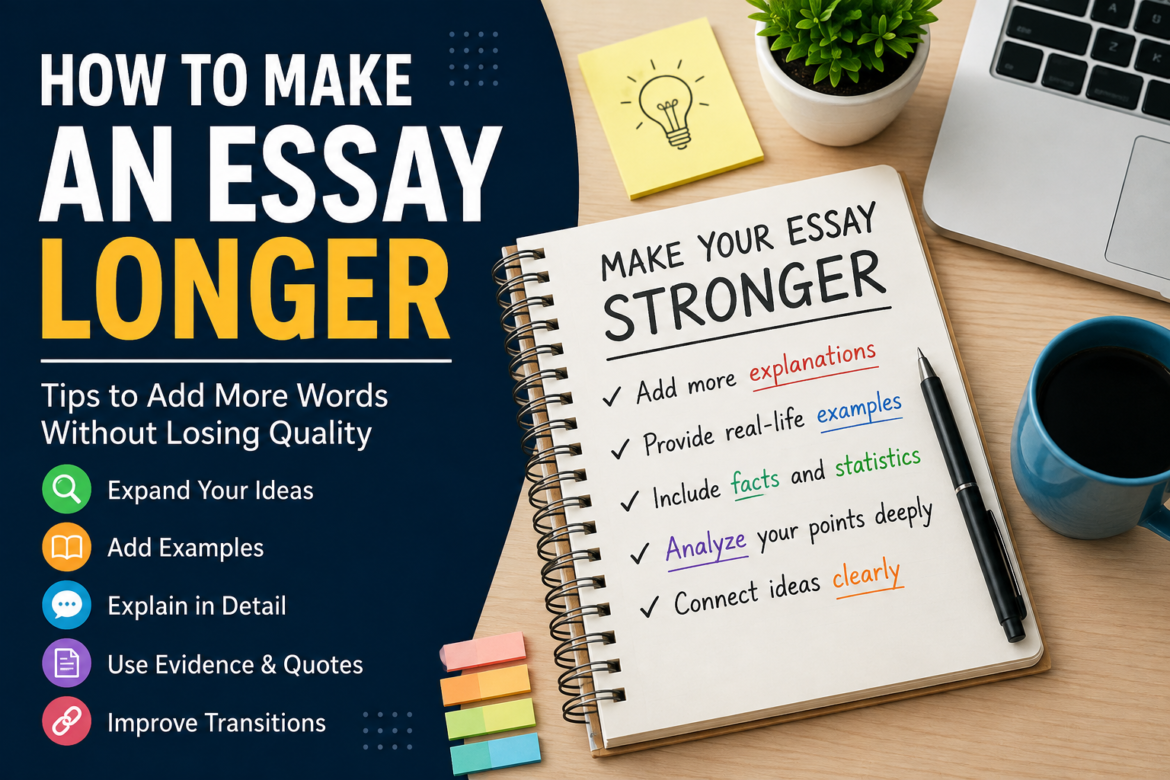
A useful way to develop body paragraphs is to follow a basic structure: make a point, explain the point, provide evidence or an example, analyze the evidence, and connect it back to the thesis. Not every paragraph needs exactly the same pattern, but this formula can help identify missing content.
If you currently have a paragraph that only makes a point and gives one sentence of explanation, you may have several opportunities to expand it. Adding analysis and connections is usually much more valuable than adding unrelated facts.
Final Thoughts on How to Make an Essay Longer
Learning how to make an essay longer is ultimately about learning how to make your ideas more complete. The best way to increase word count is not to repeat yourself or use unnecessary words but to provide deeper explanations, stronger examples, useful evidence, additional perspectives, and clearer analysis. Review every major claim and ask whether readers have enough information to understand why it matters.
Develop weak paragraphs, add relevant context, explore causes and effects, address opposing viewpoints, and connect your evidence directly to your thesis. When these techniques are used thoughtfully, an essay can become longer while also becoming clearer, more persuasive, and more valuable to the reader. A strong essay meets its required length because it has something meaningful to say, not because its writer has simply found ways to add extra words.
You Many Also Read: Career advancement strategies
1 thought on “How to Make an Essay Longer and Better: A Complete Guide”