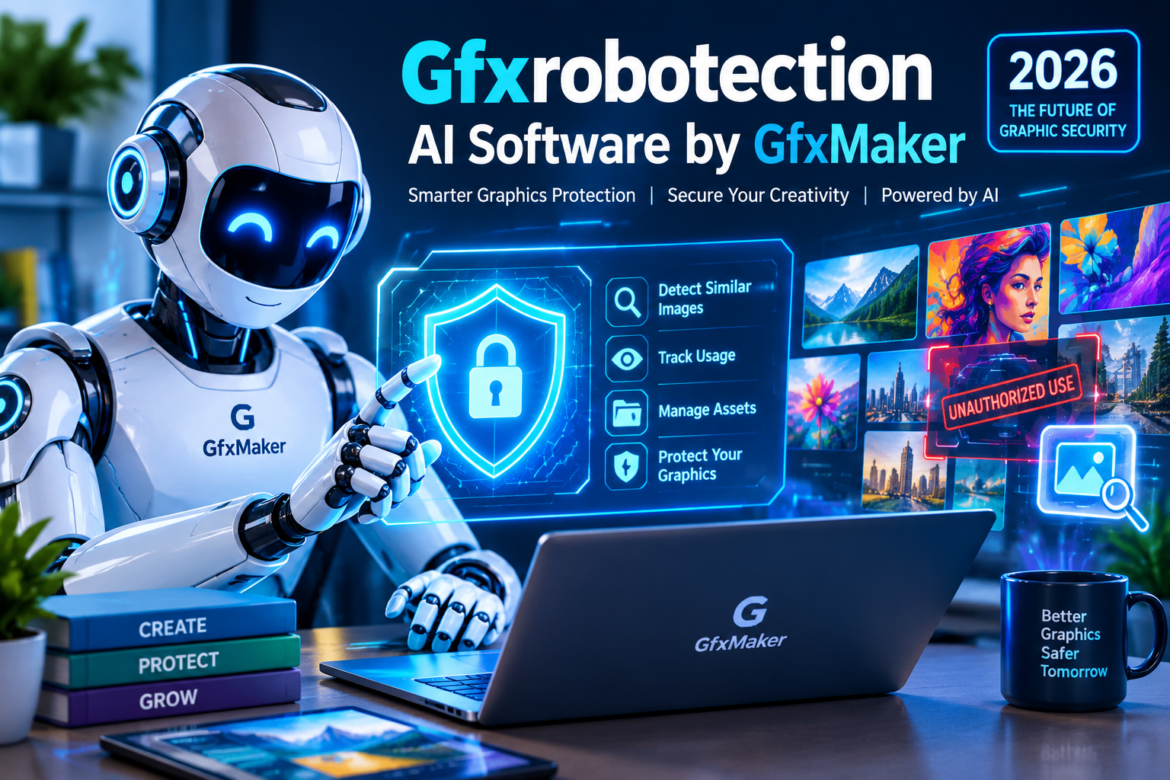
Gfxrobotection AI Software by GfxMaker: An Introduction
Gfxrobotection AI software by GfxMaker is a keyword that points toward the growing connection between artificial intelligence, graphic design, digital assets, and online content protection. As visual content becomes one of the most valuable forms of digital information, creators and businesses increasingly need tools that can help them organize, protect, analyze, and manage graphics. The idea behind an AI-focused graphics protection solution is especially relevant in 2026 because images are now used across websites, social platforms, online stores, advertising campaigns, applications, presentations, and digital publications. A modern platform associated with the term Gfxrobotection may therefore be understood in the broader context of AI-assisted graphic security and asset management rather than as a conventional image-editing program.
The phrase “Gfxrobotection AI software by GfxMaker” combines several concepts into one technology-oriented keyword. “Gfx” commonly suggests graphics, “robot” can indicate automation or artificial intelligence, and “protection” naturally relates to safeguarding digital assets. GfxMaker, meanwhile, suggests a platform or brand associated with graphics creation or management. Because niche software names can change over time and publicly available technical documentation may be limited, users should verify the exact features, developer information, compatibility, and licensing details before treating a particular description as an official specification. Nevertheless, the concept provides an interesting starting point for understanding how AI can influence the future of graphic protection.
Why Graphic Protection Matters in 2026
Digital graphics have become important business assets. A company logo, product photograph, custom illustration, advertising banner, infographic, social media design, or original artwork can require considerable time and money to produce. Once an image is published online, it can potentially be copied, modified, redistributed, or reused without the original creator’s permission. Traditional approaches to protecting graphics often involve copyright notices, watermarks, access controls, licensing agreements, and manual monitoring. AI introduces another possible layer by helping automate some of the repetitive work associated with identifying and monitoring visual assets.
The importance of graphic protection is also connected to the enormous quantity of content being published every day. Human teams cannot realistically inspect every website, marketplace, social platform, and digital archive for unauthorized use of their images. AI-powered systems can potentially assist by processing large quantities of visual information much faster than manual workflows. This does not mean that AI automatically solves every copyright or security problem. Instead, the technology can function as an additional tool that helps creators discover potentially problematic uses and organize their digital assets more efficiently.
Understanding the AI Concept Behind Gfxrobotection
Artificial intelligence can interact with graphics in several different ways. Computer vision systems, for example, can analyze images and identify objects, patterns, text, colors, faces, logos, or other visual characteristics. Image similarity technology can compare one image against another and estimate whether the two visuals have substantial similarities. Machine learning systems can also classify files according to predefined characteristics and help users search large image collections.
For a concept such as Gfxrobotection AI software by GfxMaker, these capabilities could theoretically support automated graphic monitoring and organization. An AI engine might examine uploaded assets, generate identifying information, detect visually similar copies, or assist with tracking where particular graphics appear. The exact functionality would depend on the actual implementation of the software. Therefore, users should distinguish between the general capabilities of AI-powered image technology and specific features that have been officially documented by a particular software provider.
How AI Can Help Identify Digital Graphics
One potentially useful application of AI is image recognition. Instead of depending entirely on filenames, an intelligent system can analyze the visual content of an image. This can make it easier to locate specific graphics in large collections. For example, a design team could have thousands of banners, illustrations, photographs, and marketing materials stored in different folders. AI-assisted indexing could help organize those files according to their visual characteristics.
Image similarity detection is another important concept. A graphic can be changed without completely losing its visual relationship to the original. Someone might crop an image, resize it, change its colors, add text, or place it inside another design. Advanced computer vision systems may be able to detect similarities despite some transformations. Such technology can be useful for monitoring digital assets, although the results should normally be reviewed by a person before making important legal or business decisions.
The Role of Automation in Graphic Security
Automation is one of the most attractive features of AI-based software. Traditional graphic monitoring can involve repeated manual searches, file comparisons, folder organization, and record keeping. Automated workflows can reduce the amount of repetitive work required from designers and administrators. A system could potentially scan selected resources, compare images, organize matches, and notify users when certain conditions are detected.
For businesses, automation can also improve consistency. When different employees perform the same task manually, they may use different methods or overlook certain files. An automated process can apply the same rules repeatedly. However, automation should not be treated as completely error-free. Image recognition systems can produce false positives and false negatives, particularly when images have been heavily modified or when visual similarities are common. Human review remains valuable when the consequences of a detection are significant.
GfxMaker and the Broader Graphics Software Landscape
The name GfxMaker suggests a connection with graphics creation, which makes the concept of Gfxrobotection AI software by GfxMaker particularly interesting. Graphic creation software generally focuses on producing or editing visual content, while protection-oriented software focuses on managing and safeguarding that content. Combining creation and protection into a connected workflow could provide advantages for creators who want to maintain control over their digital assets after production.
A modern graphics workflow can include brainstorming, designing, editing, exporting, publishing, licensing, monitoring, and archiving. When these activities are separated across many applications, users may have difficulty tracking where each asset originated and how it is being used. AI-based management could potentially connect some of these stages. The practical value would depend on factors such as integration, file support, automation capabilities, privacy controls, and the accuracy of the underlying AI models.
Potential Benefits for Designers
Independent designers create a large amount of original digital material, and protecting that work can be difficult. A designer may publish an illustration on a portfolio website and later discover that a similar version has appeared somewhere else. Manually searching for every possible reuse can consume valuable time. AI-assisted monitoring could potentially help identify visual matches and provide a starting point for investigation.
Another benefit could be better organization. Designers often accumulate multiple versions of the same project, including drafts, exported files, thumbnails, source documents, and final versions. Intelligent classification could make it easier to locate specific assets. When combined with appropriate naming conventions and folder structures, Gfxrobotection AI software by GfxMaker can become part of a broader digital asset management strategy rather than functioning as a standalone protection mechanism.
Possible Uses for Marketing Teams
Marketing departments depend heavily on visual content. Campaigns may include social media graphics, advertisements, product images, promotional videos, website banners, email graphics, and branded illustrations. Protecting these materials can help organizations maintain brand consistency and monitor how visual assets are being used online.
An AI-based graphic protection workflow could potentially help marketing teams identify repeated or modified uses of campaign assets. It could also support internal organization by categorizing materials according to campaign, product, format, or visual characteristics. This could reduce time spent searching for files and help teams maintain a more structured digital library.
Protecting Brand Identity With AI
Brand identity is more than a logo. It can include typography, colors, illustrations, photography styles, icons, packaging designs, and other recognizable visual elements. Unauthorized or misleading use of these materials can create confusion for customers. Gfxrobotection AI software by GfxMaker-based image analysis may provide another way to monitor the appearance of recognizable brand elements across digital environments.
Logo recognition is one example of how computer vision can be applied. A system trained or configured to identify a particular visual mark may detect instances where that mark appears within an image. However, recognition accuracy can vary depending on image quality, size, distortion, background, and other factors. Any suspected misuse should therefore be evaluated in context instead of relying solely on an automated detection result.
AI and Watermarking Technologies
Watermarking has traditionally been one method for communicating ownership or discouraging unauthorized reuse. Modern AI technologies can interact with watermarking in different ways, including helping determine whether an image contains certain embedded or visible characteristics. Some systems may also support automated watermark placement during asset publishing.
Watermarks are not a complete security solution. They can sometimes be cropped, removed, obscured, or altered. Their primary value is often deterrence, identification, or communication of ownership rather than absolute prevention of copying. A comprehensive protection strategy can combine watermarking with licensing information, access controls, monitoring, backups, and appropriate legal protections.
The Importance of Metadata and Digital Asset Records
Metadata can provide valuable information about a digital graphic. Depending on the file and workflow, metadata may include creation information, author details, copyright notices, keywords, descriptions, software information, or other technical characteristics. Maintaining accurate metadata can make digital asset management easier.
AI can potentially help generate or organize metadata by analyzing image contents. For example, an intelligent system could suggest keywords or categories based on what appears in a graphic. This can make large collections more searchable. At the same time, automatically generated metadata should be reviewed when accuracy is important, because AI-generated descriptions can sometimes misunderstand visual context.
Privacy Considerations for AI Graphics Software
Privacy is an important consideration whenever images are processed by software. Graphics may contain confidential business information, unreleased products, private photographs, customer information, or proprietary designs. Before uploading sensitive material to an AI service, users should understand how files are processed, where they are stored, how long they are retained, and whether they are used for model training.
For organizations, privacy requirements can be particularly important. A company may need to establish rules governing which graphics can be uploaded to external services. Local processing or private infrastructure may be preferred for particularly sensitive material, depending on the organization’s technical and legal requirements. Users considering any software associated with the Gfxrobotection AI software by GfxMaker concept should therefore review the provider’s current privacy documentation rather than relying on assumptions.
Security Features to Consider
When evaluating Gfxrobotection AI software by GfxMaker intended to protect graphics, users can examine several practical areas. Authentication is important because only authorized individuals should be able to access valuable assets. Permission management can control which users can view, edit, download, or delete files. Encryption can help protect information while it is stored or transmitted. Audit logs can provide records of important activities within the system.
Backup and recovery are also essential. Protection does not only mean preventing unauthorized copying. It also means reducing the risk of losing important original files because of hardware failure, accidental deletion, ransomware, or other incidents. A reliable digital asset strategy should include secure backups and a tested recovery process.
AI Detection Is Not the Same as Legal Proof
An important distinction should be made between detecting a visual similarity and establishing legal infringement. AI can potentially identify that two images look similar, but copyright law depends on jurisdiction, ownership, licensing, context, and other factors. Similarity alone does not automatically prove that a legal violation has occurred.
For this reason, an AI-generated alert should generally be treated as an investigative lead. Users may need to examine the original work, licensing terms, publication dates, permissions, and circumstances surrounding the suspected use. For serious disputes, professional legal advice may be appropriate. Technology can assist the process, but it should not replace legal analysis.
Challenges Facing AI-Based Graphic Protection
AI-powered graphic protection has several challenges. One is accuracy. Images can be transformed in countless ways, making it difficult for an automated system to determine whether two visuals are meaningfully related. Another challenge is scale. Large organizations may have enormous image libraries that require substantial storage and processing resources.
Another issue is the changing nature of digital content. Generative AI can create new images based on prompts, references, or existing visual styles. This creates additional questions about ownership, attribution, originality, and the relationship between generated content and existing works. Graphic protection software may need to evolve as these technologies develop.
Generative AI and the Future of Graphic Protection
The growth of generative AI is likely to influence the future of digital asset management. Designers can now create images much faster using AI-assisted tools, which means the volume of visual material being produced may continue to increase. More content creates a greater need for organization and tracking.
At the same time, generative systems can make visual similarities more complicated. An image may not be a direct copy but could contain recognizable elements associated with another work. Determining the significance of such similarities can be challenging. Future graphic protection platforms may therefore combine computer vision, metadata analysis, provenance information, and human review to provide more comprehensive asset management.
How Businesses Can Build a Broader Protection Strategy
Businesses should not depend on one software application to protect their visual assets. A stronger strategy can begin with a clear inventory of important graphics. Each asset can be given an appropriate name, description, ownership record, and licensing information. Access permissions can then be established so that only authorized employees can modify or distribute important files.
Monitoring can form another layer of the strategy. AI-assisted detection may help discover potentially unauthorized uses, while human review can determine whether an alert actually requires action. Backups, employee training, secure storage, copyright documentation, and appropriate contracts can complete the broader framework. Software can support this strategy, but effective protection usually involves several coordinated practices.
What Users Should Check Before Choosing AI Graphics Software
Anyone researching Gfxrobotection AI software by GfxMaker or similar products should examine the available documentation carefully. Users should look for information about supported file formats, operating systems, cloud or local processing, account requirements, pricing, data retention, privacy practices, integrations, and customer support. These details can vary significantly between platforms.
It is also useful to determine whether the software is designed primarily for image creation, image management, monitoring, copyright assistance, security, or a combination of these areas. A product may sound highly specialized based on its name while offering a more limited set of functions in practice. Reading official documentation and testing a product with non-sensitive files can help users understand whether it fits their workflow.
The Growing Importance of Responsible AI Use
Responsible AI use is becoming increasingly important as organizations adopt automated systems. Users should understand what information is being processed and how automated decisions are generated. When an AI system flags a potential copyright issue, for example, the result should be reviewed rather than automatically treated as definitive.
Transparency is equally important. Organizations using AI to monitor digital assets should establish clear internal procedures for reviewing alerts and responding to possible infringements. This can help prevent unnecessary disputes and reduce the risk of taking action based on incorrect automated results.
Gfxrobotection AI Software by GfxMaker in the 2026 Digital Environment
In 2026, the relationship between artificial intelligence and graphics continues to expand. Designers have access to more automated creative tools, while businesses manage increasingly large collections of digital assets. This environment creates a natural demand for technologies that can organize, identify, monitor, and protect visual content.
The keyword “gfxrobotection ai software by gfxmaker” fits within this wider technological discussion. Whether a particular product uses advanced computer vision, automated asset management, monitoring features, watermarking, or another approach depends on its documented implementation. The broader concept remains relevant because digital graphics are valuable assets that require practical methods of organization and protection.
Conclusion: Understanding the Potential of AI Graphic Protection
Gfxrobotection AI software by GfxMaker represents a technology-oriented concept connected to the growing need for smarter graphic management and protection. Artificial intelligence can potentially help users analyze images, organize digital libraries, identify visual similarities, automate repetitive tasks, and monitor valuable creative assets. These capabilities can be useful for designers, businesses, marketers, publishers, and other organizations that depend on original visual content.
At the same time, AI should be viewed as one component of a larger protection strategy. Automated detection does not automatically establish copyright infringement, and no single technology can guarantee that digital graphics will never be copied or misused. Privacy, security, metadata, licensing, backups, human review, and legal considerations all remain important.
As digital content continues to expand, the demand for intelligent visual asset management is likely to remain significant. Tools associated with AI-powered graphic protection may become increasingly sophisticated, particularly as computer vision and generative AI develop. For users exploring Gfxrobotection AI software by GfxMaker, the most useful approach is to examine verified product information, understand the technology’s actual capabilities, and consider how those capabilities fit into a broader digital asset protection workflow.
You Many Also Read: Gianetta Fluent



1 thought on “Gfxrobotection AI Software by GfxMaker: Exploring Smart Graphic Protection Technology in 2026”