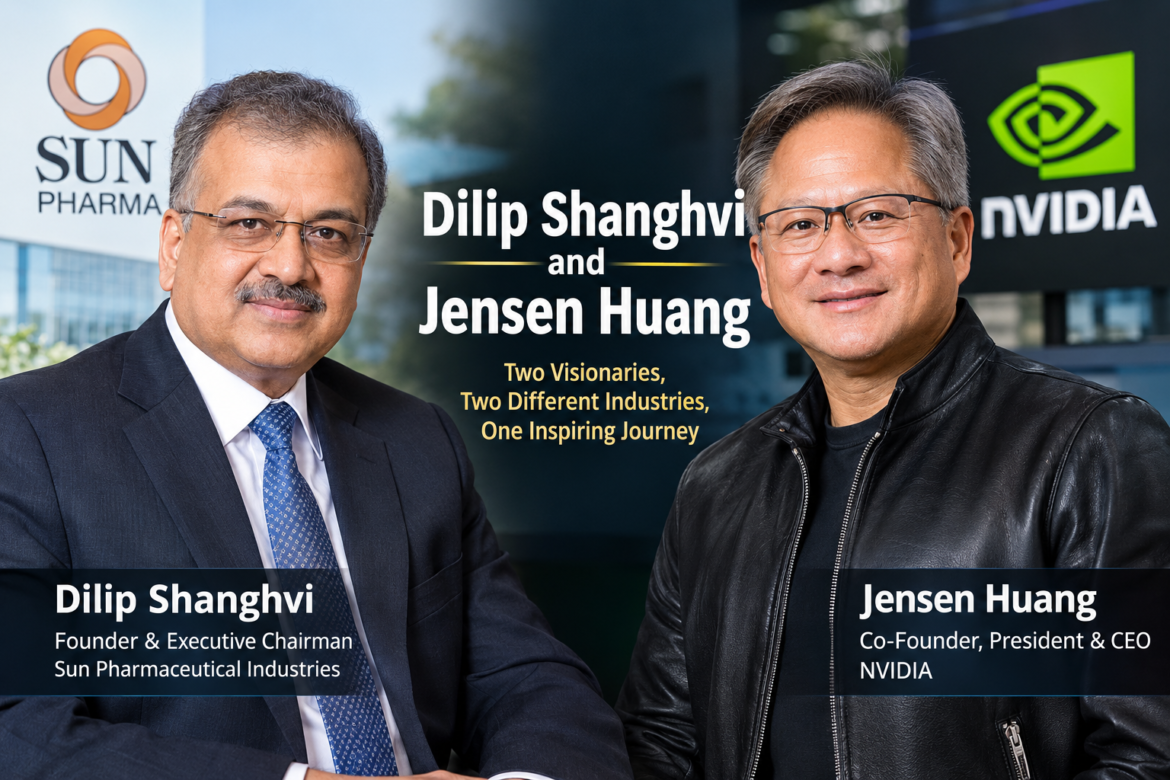
Dilip Shanghvi and Jensen Huang are two highly successful entrepreneurs whose names represent very different areas of the global economy. Shanghvi is best known for building Sun Pharmaceutical Industries into a major international pharmaceutical company, while Huang is known for co-founding NVIDIA and leading its transformation from a graphics-chip company into one of the most important technology businesses in the artificial intelligence era. Although their names may appear together in online searches, there is no reliable public evidence that Dilip Shanghvi and Jensen Huang are business partners, relatives, or founders of a shared venture.
Their real connection is more interesting as a comparison between two long-term founders who built enormous companies through specialized knowledge, persistence, innovation, and strategic decision-making. Shanghvi developed his career around healthcare and medicines, whereas Huang built his around semiconductors, accelerated computing, and artificial intelligence. Both stories demonstrate how a focused business idea can develop into a global enterprise when leadership remains committed to long-term growth.
Who Is Dilip Shanghvi?
Dilip Shantilal Shanghvi is an Indian entrepreneur and the founder of Sun Pharmaceutical Industries. Born on October 1, 1955, in Amreli, Gujarat, he later grew up in Kolkata, where his family had connections to the pharmaceutical distribution business. His early exposure to medicines and pharmaceutical trading gave him practical knowledge of the industry before he became an entrepreneur himself. Instead of remaining solely in distribution, Shanghvi recognized the potential of manufacturing medicines and decided to establish his own pharmaceutical company. Sun Pharma was founded in the early 1980s and initially focused on a relatively small number of medicines, including products for psychiatric conditions.
Shanghvi’s approach was based on gradually expanding into new therapeutic areas while building manufacturing capabilities and eventually increasing the company’s international presence. What began as a relatively small pharmaceutical operation eventually became a multinational business with products marketed across many countries. His career is often cited as an example of Indian entrepreneurship because he built a company in an industry requiring significant technical expertise, regulatory knowledge, manufacturing discipline, and long-term investment. Sun Pharma’s growth also involved acquisitions, product development, international expansion, and increasing attention to specialty medicines. Today, Shanghvi remains closely associated with Sun Pharma and serves as its Executive Chairman.
Who Is Jensen Huang?
Jensen Huang is a Taiwanese-American entrepreneur, engineer, and technology executive best known as the co-founder, President, and Chief Executive Officer of NVIDIA. He co-founded NVIDIA in 1993 with Chris Malachowsky and Curtis Priem, at a time when computer graphics was becoming an increasingly important area of technology. NVIDIA initially became recognized for graphics processing technology, particularly GPUs that could handle demanding visual workloads more efficiently than traditional processors. Over time, however, the company’s technology became useful for far more than gaming and computer graphics.
The most important part of Huang’s business story is NVIDIA’s long-term investment in accelerated computing. The company’s GPUs became increasingly useful for scientific computing, machine learning, data centers, and artificial intelligence. NVIDIA’s software ecosystem also became an important part of its strategy, helping developers use its hardware for demanding computational tasks. As artificial intelligence expanded rapidly, NVIDIA found itself positioned at the center of a major technological transformation. Huang’s leadership therefore became associated not only with graphics processors but also with the infrastructure supporting modern AI systems.
Are Dilip Shanghvi and Jensen Huang Business Partners?
One of the most important points to clarify about the keyword “Dilip Shanghvi and Jensen Huang” is that there is no established public evidence showing that the two entrepreneurs are business partners. Their major corporate histories place them in separate organizations and industries. Shanghvi is associated with Sun Pharmaceutical Industries and the global pharmaceutical sector, while Huang is associated with NVIDIA and the semiconductor and computing industries. Available public profiles do not establish a shared company, major joint venture, or formal partnership between them.
That does not necessarily mean that the two men have never met or communicated. High-profile business leaders can encounter one another at conferences, investment events, industry gatherings, or private meetings without those interactions becoming part of the public record. The accurate distinction is that no significant direct relationship has been established publicly. Therefore, it is more appropriate to compare their careers rather than present them as collaborators. Their names make sense together because both are influential founder-led business figures who have remained important to companies they helped build over several decades.
Dilip Shanghvi’s Journey With Sun Pharma
Dilip Shanghvi’s rise is closely connected to the development of Sun Pharmaceutical Industries. His early understanding of pharmaceutical distribution helped him identify opportunities in manufacturing. Rather than attempting to compete immediately across every part of the industry, Sun Pharma initially concentrated on selected therapeutic categories. This focused strategy allowed the company to build expertise, establish products, and gradually expand its operations.
Over the years, Sun Pharma grew through a combination of organic expansion and acquisitions. Shanghvi became known for recognizing opportunities where established businesses or pharmaceutical portfolios could complement Sun Pharma’s existing capabilities. The company’s acquisition strategy eventually helped it become one of India’s most significant pharmaceutical enterprises. A particularly important milestone was Sun Pharma’s acquisition of Ranbaxy Laboratories, a transaction that substantially increased the scale and international reach of the business.
Shanghvi’s leadership has also extended beyond commercial operations. Sun Pharma has invested in research and development and has expanded its presence in specialty medicines. Shanghvi is also associated with Sun Pharma Advanced Research Company, which focuses on research involving innovative drugs and drug-delivery technologies. His continued role as Executive Chairman means that his influence remains connected to the company’s long-term strategic direction even after changes in day-to-day executive leadership.
Jensen Huang’s Transformation of NVIDIA
Jensen Huang’s career followed a completely different path. When NVIDIA was established in 1993, the future dominance of artificial intelligence was not obvious. The company was initially focused on computer graphics, an industry that was developing rapidly alongside increasingly sophisticated video games, professional visualization, and personal computing.
Huang’s most important strategic achievement was maintaining a long-term vision for GPU-based accelerated computing. NVIDIA continued investing in technology that could perform highly parallel calculations, and these capabilities eventually became extremely valuable for machine learning. The development of CUDA and the wider NVIDIA software ecosystem helped turn the company’s hardware into part of a broader computing platform rather than simply a graphics component.
When AI workloads began expanding dramatically, NVIDIA was already positioned to provide much of the underlying computing infrastructure. This created an extraordinary opportunity for the company. Huang increasingly became one of the most recognizable executives in the technology industry, while NVIDIA’s business expanded into data centers, AI infrastructure, robotics, scientific computing, and other advanced applications. His career demonstrates the value of investing in an emerging technology long before its commercial potential becomes obvious.
Dilip Shanghvi vs. Jensen Huang: Different Industries
The most obvious difference between Dilip Shanghvi and Jensen Huang is the industries in which they built their fortunes. Shanghvi operates primarily in pharmaceuticals and healthcare, while Huang operates in semiconductors, computing, and artificial intelligence. These industries have completely different development cycles, regulations, customers, and competitive pressures.
Pharmaceutical companies must deal with clinical research, regulatory approvals, manufacturing standards, patents, safety requirements, distribution networks, and changing healthcare needs. A successful pharmaceutical business may spend years developing products and navigating regulatory systems before a medicine reaches patients. Shanghvi’s career therefore reflects the importance of patience, operational efficiency, strategic acquisitions, and long-term market development.
NVIDIA operates in a technology environment where product generations can change rapidly. Semiconductor performance, software ecosystems, computing architectures, data-center requirements, and AI workloads all evolve at high speed. Huang’s success has required enormous investment in research, engineering, software, and ecosystem development. His leadership illustrates the importance of anticipating technological shifts rather than simply responding to existing demand.
What Do Dilip Shanghvi and Jensen Huang Have in Common?
Despite their enormous differences, Dilip Shanghvi and Jensen Huang share several important characteristics. Both built businesses around specialized knowledge. Shanghvi understood pharmaceuticals and identified opportunities in medicine manufacturing and global healthcare. Huang understood computing and recognized the potential of parallel processing and graphics technology.
Another similarity is their extraordinary commitment to long-term company building. Shanghvi has been associated with Sun Pharma since its early development, while Huang has remained NVIDIA’s chief executive since its founding. Both leaders therefore represent a style of entrepreneurship in which founders remain deeply connected to the strategic development of their organizations over many years.
Their stories also demonstrate the importance of adapting to changing markets. Sun Pharma moved beyond its original focused product base into a much broader international pharmaceutical operation. NVIDIA moved from graphics into accelerated computing and AI. In both cases, the companies became much larger and more influential than their original business models might have suggested.
Leadership Styles of Shanghvi and Huang
Dilip Shanghvi is generally associated with a comparatively private and analytical business personality. His career has focused heavily on strategic expansion, acquisitions, pharmaceutical operations, and long-term value creation. His public profile has often been less theatrical than that of some technology executives, but his influence within the pharmaceutical industry has been substantial.
Jensen Huang has developed a much more visible public identity. He is frequently seen at technology conferences, product announcements, investor events, and AI-related gatherings. His recognizable appearance, including his trademark leather jacket, has become part of his public image. More importantly, Huang regularly communicates a broad vision of how accelerated computing and AI may reshape industries.
These differences do not necessarily indicate that one leadership approach is better than the other. They reflect the requirements of their industries and personal approaches to communication. Shanghvi’s business career has been built around careful pharmaceutical expansion, while Huang’s leadership increasingly requires him to communicate a technological vision to developers, investors, governments, and businesses around the world.
Education and Professional Background
The educational paths of Dilip Shanghvi and Jensen Huang also show the contrast between their careers. Shanghvi studied commerce and developed practical experience through his family’s pharmaceutical distribution business before establishing Sun Pharma. His early exposure to the commercial side of medicines gave him an understanding of the market that became valuable when he entered manufacturing.
Huang followed an engineering-focused path. He studied electrical engineering at Oregon State University and later earned a master’s degree from Stanford University. Before co-founding NVIDIA, he gained experience in the semiconductor industry. This technical foundation became particularly relevant as NVIDIA evolved from graphics hardware toward highly specialized computing platforms.
The difference is useful because it demonstrates that successful entrepreneurship does not require a single educational formula. Shanghvi’s commercial and industry knowledge helped him build a pharmaceutical empire, while Huang’s engineering background supported his work in advanced semiconductor technology. Both combined their initial expertise with strong business judgment.
Their Impact on Global Business
The influence of Dilip Shanghvi extends beyond Sun Pharma. His success helped demonstrate that an Indian pharmaceutical company could build a significant international presence and compete in a highly regulated global industry. Sun Pharma’s expansion has contributed to India’s broader position in the worldwide pharmaceutical market.
Jensen Huang’s influence is similarly broader than NVIDIA itself. The company’s GPUs and software ecosystem have become important components of modern AI infrastructure. As companies and research institutions increasingly use machine learning, large-scale computing, and accelerated workloads, NVIDIA’s technology has become an important part of the global technology landscape.
This difference in impact is worth noting. Shanghvi’s influence is closely tied to medicines, healthcare, manufacturing, and pharmaceutical business development. Huang’s influence is closely connected to computing infrastructure, AI, semiconductors, and the future of digital technology. Both demonstrate how one company’s strategic direction can affect an entire industry.
Net Worth and Business Success
Dilip Shanghvi and Jensen Huang are both frequently included among the world’s wealthiest entrepreneurs, but their fortunes come from different sources and should not be treated as fixed numbers. Shanghvi’s wealth is strongly connected to his ownership and interests in Sun Pharma and related investments, while Huang’s wealth is heavily connected to his ownership of NVIDIA shares. Because publicly traded stock prices can change substantially, billionaire wealth estimates can move significantly from one day to another.
For that reason, exact net-worth figures should always be treated as estimates rather than permanent facts. What is more meaningful is the business value created through their companies. Shanghvi built Sun Pharma into a major global pharmaceutical organization, while Huang helped transform NVIDIA into a leading company in accelerated computing and AI. Their financial success is ultimately a result of long-term ownership, company growth, and strategic leadership.
Why Their Stories Matter in 2026
In 2026, the careers of Dilip Shanghvi and Jensen Huang remain relevant because both companies continue to operate in sectors experiencing major structural change. Healthcare is evolving through biotechnology, specialty medicines, personalized treatment approaches, and new drug-development technologies. Technology is being transformed by artificial intelligence, advanced chips, robotics, and increasingly powerful computing systems.
Shanghvi’s story offers lessons about building a global healthcare business patiently and strategically. Huang’s story offers lessons about investing in technological platforms before their full potential becomes obvious. Their companies also show that successful organizations cannot remain dependent on their original business models forever. They must continue investing, adapting, and finding new opportunities.
What Entrepreneurs Can Learn From Dilip Shanghvi and Jensen Huang
There are several valuable lessons that can be drawn from comparing these two entrepreneurs. The first is the importance of specialization. Shanghvi developed deep expertise in pharmaceuticals, while Huang developed deep expertise in computing technology. Both used specialized knowledge as the foundation for much larger businesses.
The second lesson is patience. Neither Sun Pharma nor NVIDIA became globally influential overnight. Their development required decades of investment, experimentation, expansion, and adaptation. Entrepreneurs often focus on rapid growth, but these stories show the potential benefits of building capabilities that can survive changing market conditions.
The third lesson is strategic adaptation. Sun Pharma expanded beyond its initial focus, while NVIDIA moved far beyond traditional graphics. Businesses that successfully evolve can discover opportunities that were not part of their original plans. Finally, both stories demonstrate the importance of leadership continuity. Remaining deeply involved in a company’s long-term strategy can help founders preserve a clear vision while allowing the organization to grow around them.
Final Thoughts on Dilip Shanghvi and Jensen Huang
Dilip Shanghvi and Jensen Huang are not best understood as business partners or members of the same corporate venture. There is no reliable public evidence establishing a major direct relationship between them. Instead, their names are valuable together because they represent two extraordinary examples of long-term entrepreneurship. Shanghvi built Sun Pharmaceutical Industries into a major global pharmaceutical company, while Huang helped transform NVIDIA from a graphics-focused technology business into a central force in accelerated computing and artificial intelligence.
Their careers are separated by industry, education, geography, and business model, yet they share an important entrepreneurial characteristic: the ability to think beyond the immediate opportunity. Shanghvi saw possibilities in pharmaceutical manufacturing and gradually expanded into a global healthcare business. Huang saw possibilities in GPU technology and helped develop an ecosystem that became increasingly important to AI. Their stories show that lasting business success often comes from combining specialized knowledge with patience, adaptability, innovation, and a willingness to invest in the future.
You Many Also Read: Mary-Kate and Ashley Olsen



1 thought on “Dilip Shanghvi and Jensen Huang: Two Billionaire Founders, Two Remarkable Business Journeys”