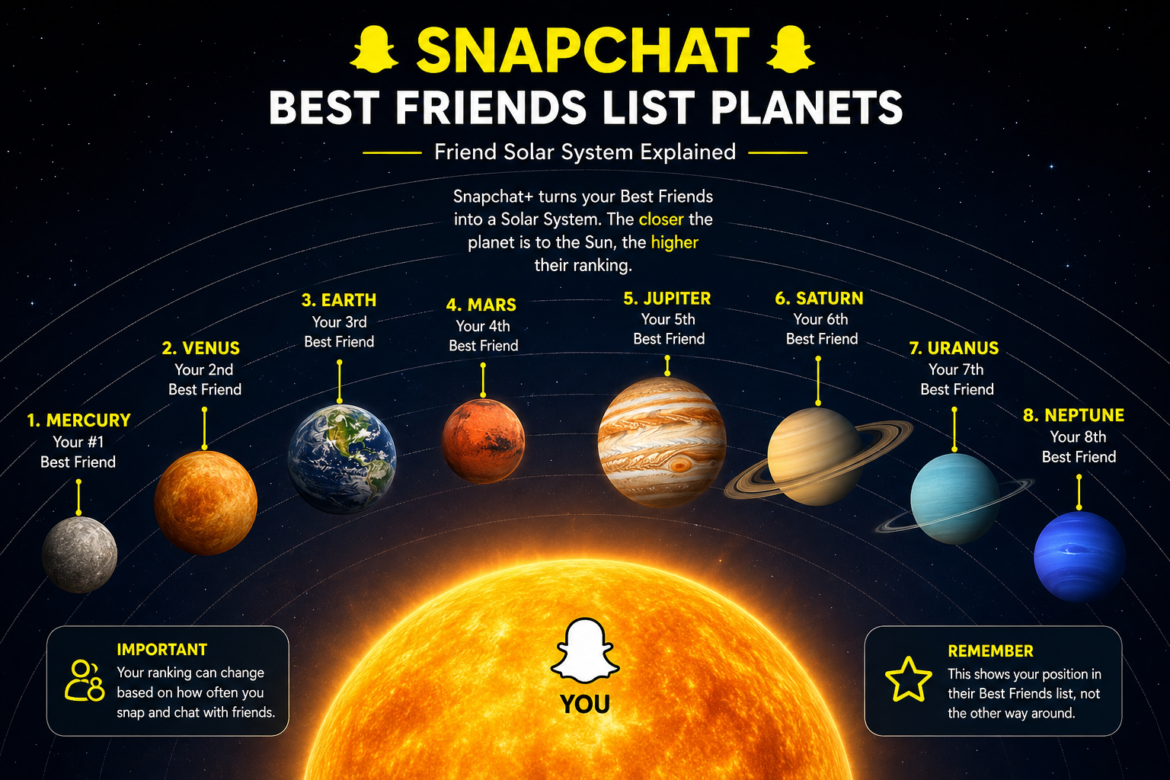
What Are Best Friends List Planets?
Best friends list planets are a Snapchat feature that turns a user’s closest friendships into a visual solar system. Instead of simply displaying a numbered ranking, Snapchat uses the eight planets from Mercury through Neptune to represent positions within a person’s Best Friends list. The idea is simple: the closer a planet is to the Sun, the higher the friend ranks.
Mercury represents the first position, while Neptune represents the eighth position. This feature is known as Friend Solar System and is associated with Snapchat+, giving users a more playful way to understand their position within another person’s closest Snapchat connections.
How the Snapchat Best Friends List Works
Best friends list planets is based on the people with whom an account interacts most frequently through activities such as Snaps and Chats. The list can include up to eight people, and the ranking can change as communication patterns change. The Friend Solar System does not create an entirely separate friendship list; instead, it provides a visual representation of positions within the existing Best Friends system.
This distinction is important because seeing a particular planet does not necessarily mean that the person has been permanently assigned that position. Your ranking can move as your interactions with different friends change over time.
Mercury Means Your Number One Friend
Mercury is the first planet and represents the number one position in the Best friends list planets. If you appear as Mercury in another person’s Friend Solar System, it means you currently hold the highest-ranked position among that person’s Snapchat friends. In practical terms, this reflects a particularly high level of interaction on the platform.
Mercury is closest to the Sun in the real solar system, which makes it a natural choice for Snapchat’s closest friendship position. It is important to remember that Mercury describes Snapchat interaction ranking rather than making a judgment about the overall quality or importance of a real-life friendship.
Venus Represents the Second Position
Venus is the second planet in the Friend Solar System and represents the second position on a person’s Best friends list planets. Someone shown as Venus is therefore one of the people that account interacts with most frequently, although another person currently occupies the number one position.
Venus can represent a very active Snapchat connection, but the ranking is dynamic. If communication with another friend increases or decreases, the positions can change. Therefore, Venus should be viewed as a current snapshot of Snapchat interaction rather than a permanent label attached to a friendship.
Earth Represents the Third Best Friend
Earth occupies the third position in the Snapchat planet order. If you are represented by Earth in someone’s solar system, you are currently their third-ranked friend within the system. The use of Earth is particularly recognizable because it is the planet on which we live, but its real-world importance has no additional meaning within Snapchat.
The feature simply borrows the familiar planetary order to make the Best friends list planets easier and more entertaining to visualize. Earth can therefore be understood as position number three rather than a special category of friendship.
Mars Represents the Fourth Position
Mars is the fourth planet and corresponds to the fourth position in the Best friends list planets ranking. A Mars position means that you are among the person’s eight closest Snapchat connections but are currently ranked fourth. This can still indicate frequent interaction, especially when compared with the many people who are not included in the top eight.
The important thing to understand is that every planet from Mercury through Neptune represents a place in the same ranking system. Mars does not mean a friendship is weaker or stronger in an emotional sense; it only indicates its current position according to Snapchat’s system.
Neptune Represents the Eighth Position
Neptune is the eighth and final planet used in Snapchat’s Friend Solar System. It represents the eighth position on the Best friends list planets. Because Neptune is farthest from the Sun in the traditional eight-planet solar system, it naturally occupies the final position in Snapchat’s visual ranking.
A Neptune position means that the person is currently within the top eight represented connections but ranks eighth. It does not mean that the friendship has no value. It simply describes the person’s current position within Snapchat’s interaction-based ranking.
Why Snapchat Uses Eight Planets
The use of eight planets makes the feature easy to understand because the modern solar system is commonly represented as having eight planets. Snapchat connects those eight planets with the eight positions in its Best friends list planets system. This creates a simple visual metaphor.
The user is represented as the Sun, while the closest connections orbit around them. Mercury is closest and Neptune is farthest, allowing users to understand ranking without needing to memorize a complicated numerical system. The concept also makes an ordinary social-media ranking feel more interactive and entertaining.
What the Sun Means in the Friend Solar System
In Snapchat’s Friend Solar System, the user whose friendship profile you are viewing is treated as the Sun. The planets surrounding that Sun represent the positions of that person’s closest friends. This is different from looking at the planets from your own perspective.
Your position in someone else’s solar system tells you where you stand on their Best Friends list, while your own solar system represents the people who rank highest in your interactions. This perspective is one of the most important details to understand when interpreting the feature.
Are Best Friends List Planets Mutual?
A planet ranking does not automatically mean that both people have identical Best friends list planets. Friendship rankings can be viewed from an individual account’s perspective, so one person can rank highly in another person’s list without necessarily ranking in exactly the same position on their own list.
Snapchat distinguishes between a “Best friends list planets” relationship and a “Friends” relationship within the relevant profile experience. The Best Friends indication can mean that both users are among each other’s closest connections, while the Friends indication can show a one-sided top-eight position.
Why Your Planet Can Change
Your Snapchat planet is not necessarily permanent because the Best Friends ranking reflects changing interaction patterns. If you begin sending more Snaps or having more conversations with one person, that person may move higher in the ranking. At the same time, reduced interaction with another person can cause their position to fall.
The precise algorithm Snapchat uses to determine every ranking factor is not publicly explained in full, so it is better to think of the planets as an indication of relative interaction rather than a precise formula. Current guides agree that the rankings can change as user activity changes.
What Affects Your Best Friends Ranking?
Snapchat does not provide a complete public formula explaining every factor behind Best friends list planets rankings, so users should be cautious about claims that assign exact percentages or guaranteed ranking rules. However, the feature is generally described as being connected to how frequently people interact through Snapchat, particularly Snaps and Chats.
Other forms of engagement may also contribute to the broader friendship experience, but there is no reliable reason to assume that one specific action guarantees a particular planet. The safest interpretation is that more meaningful and frequent interaction can influence your relative position, while the ranking can change over time.
Why People Find the Planet System Interesting
The planetary system adds a game-like element to ordinary social communication. Instead of seeing a simple list of names, users can imagine their closest Snapchat connections orbiting around them. This visual approach makes the ranking easier to remember and encourages curiosity about where people stand.
It also reflects a broader trend in social applications toward turning interaction statistics into visual features. The Friend Solar System takes information that might otherwise feel like a technical ranking and presents it in a format that is familiar, colorful, and easy to explore.
Common Misunderstandings About Snapchat Planets
One common misunderstanding is that the largest planet must represent the closest friend. That is not how the system works. Jupiter is physically larger than Mercury, but Mercury still represents the number one position because Snapchat follows planetary order from the Sun.
Another misconception is that a planet represents a permanent friendship status. In reality, positions can change as interactions change. Users should also avoid assuming that a planet automatically proves that two people have identical rankings. The Friend Solar System is based on individual perspectives and should be interpreted accordingly.
Best Friends List Planets vs. Best Friend Emojis
Snapchat’s planetary system should not be confused with its Best Friend emojis. Emojis can indicate particular friendship milestones or interaction patterns, while the Friend Solar System uses planets to represent positions in a top-eight ranking. The two features can therefore provide different types of information.
A planet tells you where you stand within a friend’s ranked solar system, whereas an emoji can communicate a particular status or milestone. Understanding this distinction prevents users from interpreting every Snapchat symbol as part of the same ranking system.
Can You Move From Neptune to Mercury?
A person can potentially move from a lower-ranked position to a higher-ranked position as interaction patterns change, but there is no guaranteed shortcut for moving directly from Neptune to Mercury. The ranking reflects relative activity, so increasing communication with one person while reducing interaction with others can change the order.
It is also important not to treat this as a competition. Trying to manipulate every interaction simply to obtain a particular planet can make social media less enjoyable. The planets are designed as a playful feature rather than a formal measure of personal relationships.
Privacy and Social Interpretation
Because the planets can reveal relative interaction rankings, users may sometimes take them more seriously than intended. A person might feel disappointed about being Neptune rather than Mercury, even though the ranking only reflects Snapchat activity. It is important to keep digital indicators in perspective.
People communicate differently across platforms, and someone’s Snapchat activity may not represent their overall social life. The best way to use the feature is as an entertaining snapshot of app-based interaction rather than as evidence about how much someone cares about you.
Final Thoughts on Best Friends List Planets
Best friends list planets provide a creative way to understand Snapchat’s top-eight friendship ranking. The Friend Solar System uses Mercury through Neptune to represent positions from first to eighth, with the person whose profile you are viewing acting as the Sun. Mercury represents the closest ranked connection, while Neptune represents the eighth position. The feature is connected to Snapchat+ and is designed to make digital friendships more visual and engaging.
The most important thing to remember is that these planets describe Snapchat interaction, not the complete value of a friendship. Rankings can change as communication patterns change, and your position in another person’s solar system may not match their position in yours. Once you understand the order and perspective, the feature becomes much easier to interpret. Whether you are trying to understand why you are Mercury, Venus, Earth, or Neptune, the basic rule remains the same: the closer the planet is to the Sun, the higher the position on that person’s Best Friends list.
You Many Also Read: Leonardo DiCaprio and Emma Walmsley
1 thought on “Best Friends List Planets: Complete Guide to Snapchat’s Friend Solar System”