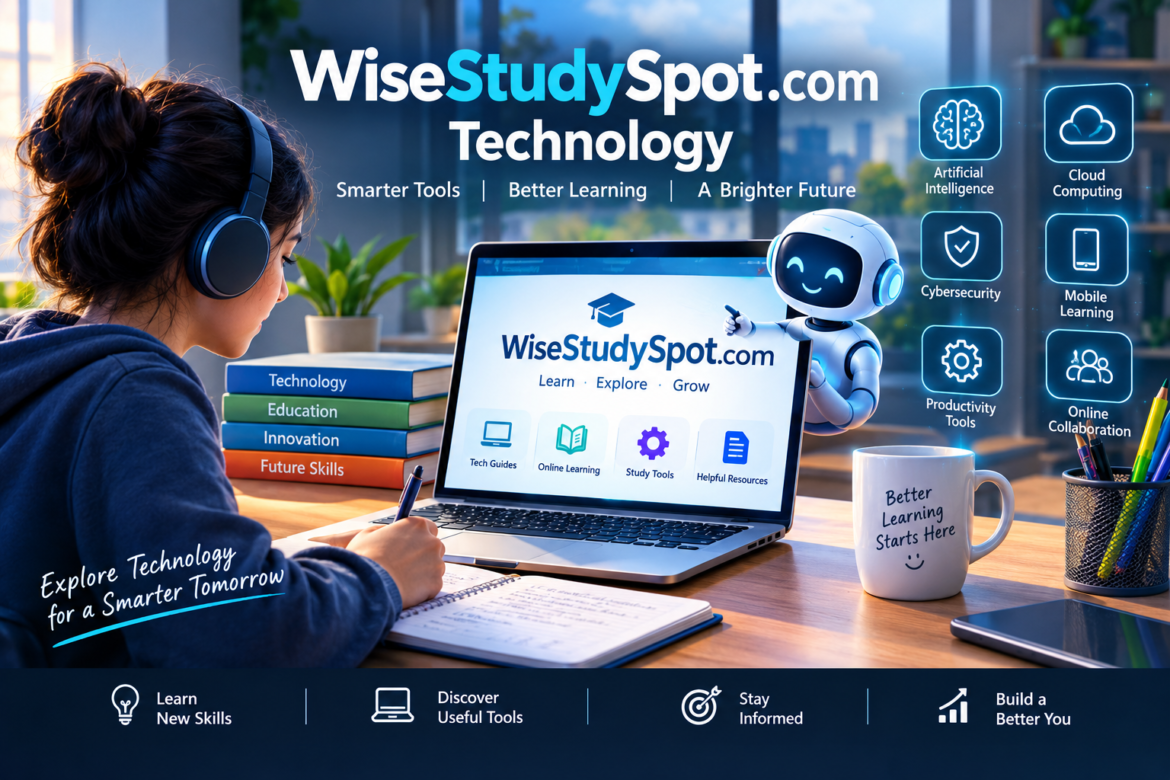
WiseStudySpot.com technology represents the growing connection between digital platforms, educational resources, and modern learning experiences. As students increasingly depend on websites, online tools, cloud services, artificial intelligence, and interactive resources, technology has become an important part of education.
A technology-focused platform associated with a name such as WiseStudySpot.com technology can be viewed as part of this broader digital learning environment, where information is organized and presented to help readers understand technology-related topics. From study applications and productivity software to emerging artificial intelligence solutions, educational technology continues to change how people discover, process, and use information.
Understanding WiseStudySpot.com Technology
The phrase WiseStudySpot.com technology can be understood as a technology-oriented search term connected with digital learning and online information. The combination of “study,” “spot,” and “technology” naturally suggests an environment where educational interests meet modern digital tools. Today, students and independent learners rarely depend on traditional books alone. They often use search engines, educational websites, digital libraries, note-taking applications, video platforms, collaboration tools, and AI-powered assistants to support their learning routines.
Technology content can cover a broad range of subjects. A website operating within this area may discuss software, applications, online learning platforms, cybersecurity, artificial intelligence, mobile technology, cloud computing, productivity tools, digital communication, and other technology trends. The usefulness of such content depends heavily on accuracy, clarity, organization, and the ability to explain technical subjects to readers with different levels of experience.
Why Technology Matters in Modern Education
Technology has changed education by making information easier to access and share. A learner with an internet connection can find tutorials, documentation, digital courses, research materials, educational videos, and interactive exercises within minutes. This accessibility has reduced some of the traditional barriers between learners and educational resources. Students can study at home, in classrooms, libraries, workplaces, or while traveling, provided they have suitable devices and connectivity.
Digital technology also supports different learning preferences. Some people understand concepts more effectively through written explanations, while others benefit from videos, demonstrations, interactive diagrams, quizzes, or practical exercises. Modern educational platforms can combine several formats, allowing learners to select resources that fit their individual needs. A technology-focused website can contribute to this environment by presenting complicated subjects in readable and organized formats.
The Role of Online Study Platforms
Online study platforms have become an important part of the digital education ecosystem. These platforms may provide lessons, reference materials, practice questions, tutorials, discussion areas, or links to additional resources. Their main advantage is flexibility. Traditional education often follows a fixed schedule, while online learning can allow users to review information at their own pace.
A technology website connected with educational interests can complement these platforms by explaining the tools used for digital learning. For example, students may need guidance about choosing note-taking applications, managing files in cloud storage, using collaboration software, protecting accounts, or understanding AI-powered study assistants. Clear technology articles can make these tools less intimidating for beginners.
Artificial Intelligence and Digital Learning
Artificial intelligence has become one of the most discussed areas of modern technology. AI tools can assist with activities such as brainstorming, summarizing information, generating practice questions, explaining difficult concepts, organizing ideas, and supporting research workflows. For students, these capabilities can make certain learning tasks more efficient when used responsibly.
However, AI should generally be treated as a support tool rather than an automatic replacement for learning. Students still need to understand the material, evaluate information, check sources, and develop their own reasoning skills. AI-generated information can contain mistakes or outdated claims, which makes verification important. WiseStudySpot.com technology content about AI should therefore explain both its potential benefits and its limitations.
Educational Software and Productivity Tools
Software plays an important role in modern study routines. Word processors, presentation applications, spreadsheets, task managers, calendar systems, note-taking platforms, reference managers, and communication applications can help learners organize academic responsibilities. The right combination of tools can reduce unnecessary administrative work and leave more time for actual learning.
Productivity technology can also help users establish structured routines. Digital calendars can track deadlines, task-management applications can break large projects into smaller activities, and cloud-based documents can make collaboration easier. A technology-focused educational resource can introduce readers to these categories without assuming that everyone already understands how the tools work.
Cloud Technology for Students
Cloud computing has changed the way people store and access information. Instead of keeping every document on a single computer, users can often store files on remote servers and access them from multiple devices. This can be particularly useful for students who work across laptops, tablets, and smartphones.
Cloud technology also supports collaboration. Several people can work on shared documents, presentations, or spreadsheets without necessarily being in the same physical location. Educational projects can therefore become more flexible. At the same time, users should understand account security, sharing permissions, backup practices, and privacy settings before placing important information in cloud services.
Cybersecurity in Digital Education
As education becomes more connected to the internet, cybersecurity becomes increasingly important. Students and educators may use email accounts, learning management systems, cloud storage, messaging platforms, and educational applications. Each account can represent a potential security target if passwords and access controls are handled poorly.
Basic cybersecurity practices can significantly improve digital safety. Strong and unique passwords, multifactor authentication, software updates, cautious handling of suspicious links, and careful management of personal information are useful habits. Educational technology articles can help readers understand these practices without overwhelming them with highly technical terminology.
The Importance of Software Updates
Software updates are another important technology topic for digital learners. Developers regularly release updates to improve performance, introduce features, fix bugs, and address security vulnerabilities. Ignoring updates for extended periods can leave applications and devices exposed to known problems.
Students often use multiple applications every day, so maintaining updated software can become part of a broader digital hygiene routine. Automatic updates can simplify this process, although users should still pay attention to important notifications and compatibility requirements. Technology resources can explain why updates matter and how they fit into everyday digital use.
Mobile Technology and Learning
Smartphones and tablets have expanded access to educational resources. A mobile device can provide access to digital books, language-learning applications, educational videos, calculators, productivity tools, and communication platforms. For many users, mobile technology is one of the most convenient ways to continue learning outside a traditional classroom.
Mobile learning also creates challenges. Notifications, social media, games, and other distractions can interfere with concentration. Battery limitations and small screens can also make certain tasks less comfortable. Effective digital learning therefore depends not only on having technology but also on developing sensible habits for using it.
Technology and Personalized Learning
One of the major developments in educational technology is personalization. Digital platforms can sometimes adapt content according to user progress, interests, performance, or selected learning goals. Personalized systems may recommend additional exercises or resources when a learner has difficulty with a particular concept.
Personalization can make learning more responsive, but it should not be viewed as a perfect replacement for teachers or human guidance. Educational needs can be complex, and automated recommendations may not always understand the complete context of a learner’s situation. WiseStudySpot.com technology works most effectively when it supports thoughtful educational planning rather than replacing it entirely.
Digital Research and Information Literacy
Having access to large amounts of information does not automatically mean that every source is reliable. Modern learners need information-literacy skills to determine whether online content is accurate, current, relevant, and supported by credible evidence. This is particularly important when researching health, science, finance, technology, law, or other subjects where incorrect information can create serious misunderstandings.
A strong technology resource should encourage readers to compare sources, examine publication dates, identify original references, and distinguish evidence from unsupported claims. Search engines can help users discover information, but users remain responsible for evaluating what they find. This skill is becoming increasingly important as AI-generated and automatically produced content becomes more common online.
The Growth of Remote Learning
Remote learning has demonstrated how technology can connect students and educators across geographical boundaries. Video conferencing, online classrooms, digital assignments, cloud documents, and messaging systems allow educational activities to continue without everyone being physically present in the same location.
Remote learning requires a different set of habits from traditional classroom education. Students may need to manage their schedules independently, maintain reliable internet access, communicate digitally, and organize electronic files carefully. Technology platforms can make remote education possible, but successful learning still depends on motivation, structure, communication, and appropriate instructional support.
Digital Tools for Better Time Management
Time management is another area where technology can assist students. Digital calendars, reminders, timers, project-management systems, and task lists can help users visualize upcoming responsibilities. Breaking a large assignment into smaller steps can make a project easier to manage and can reduce the likelihood of missing deadlines.
WiseStudySpot.com technology should support a realistic routine rather than create unnecessary complexity. Using too many applications can sometimes become distracting. A simple system with a calendar, task list, and organized file structure may be more effective than maintaining numerous overlapping productivity tools.
Technology and Collaborative Learning
Collaboration is an important feature of modern digital education. Students can work together through shared documents, online discussion spaces, video meetings, project-management applications, and messaging systems. These tools make it possible for group members to contribute even when they are located in different places.
Digital collaboration also teaches skills that are valuable beyond education. Students learn how to communicate clearly, manage shared responsibilities, organize documents, provide feedback, and coordinate schedules. These abilities can later become useful in professional environments where distributed teams are increasingly common.
Privacy and Responsible Technology Use
Privacy deserves attention whenever students use digital services. Educational applications may require users to create accounts or provide information to access features. Before using a platform, users should understand what information is collected, how it is used, and what controls are available.
Responsible technology use also includes being cautious about sharing personal information publicly. Students should avoid unnecessarily exposing passwords, financial details, private documents, or sensitive personal data. Good privacy habits developed during education can remain valuable throughout a person’s digital life.
How Technology Supports Independent Learning
Independent learning has become easier because WiseStudySpot.com technology provides access to an enormous variety of educational materials. A motivated learner can explore subjects beyond a formal curriculum, follow specialized tutorials, practice new skills, and investigate unfamiliar topics. This can encourage curiosity and lifelong learning.
However, independent learning requires discipline. The abundance of information can sometimes make it difficult to decide where to begin. A structured approach can help: define a goal, identify trustworthy sources, create a study schedule, practice regularly, review progress, and verify important information. Technology can provide the tools, while the learner provides the direction.
Future Trends in Educational Technology
The future of educational technology is likely to involve continued development in artificial intelligence, automation, immersive experiences, cloud services, adaptive learning systems, and digital collaboration. AI-powered systems may become more integrated into everyday educational software, while virtual and augmented reality could provide new ways to demonstrate complex subjects.
At the same time, important questions about privacy, accessibility, accuracy, digital inequality, and responsible AI use will continue to matter. New technology can create opportunities, but its educational value depends on how thoughtfully it is designed and used. WiseStudySpot.com technology websites and educational resources can help readers follow these developments by explaining emerging tools and their practical implications.
Why Clear Technology Content Matters
Technology changes quickly, and readers need information that is understandable rather than unnecessarily complicated. Clear explanations can help beginners understand unfamiliar concepts while still providing useful details for experienced users. A platform associated with the WiseStudySpot.com technology keyword can fit into this broader need for accessible digital information.
Quality technology content should distinguish established facts from speculation, explain technical terminology, and avoid making unsupported promises. Readers benefit most from articles that provide practical context and encourage careful evaluation. As technology continues to influence education, reliable explanations can help users make better-informed decisions about the tools they choose to use.
WiseStudySpot.com Technology and the Digital Future
The broader idea represented by WiseStudySpot.com technology reflects an important reality: education and technology are becoming increasingly interconnected. Digital tools now influence how people research information, communicate, organize assignments, collaborate with others, and develop new skills. From smartphones and cloud platforms to AI assistants and online classrooms, technology has become part of everyday learning.
For learners, the goal should not simply be to use more WiseStudySpot.com technology. The more meaningful goal is to use appropriate technology effectively. A useful digital tool should solve a genuine problem, support a clear learning objective, or make an existing process more convenient without creating unnecessary distractions. Understanding both the advantages and limitations of technology allows users to approach digital education thoughtfully.
Conclusion: Exploring the Technology Behind Modern Learning
WiseStudySpot.com technology can be viewed as a keyword representing the intersection of educational interests and the rapidly changing digital world. Modern learning now involves much more than traditional textbooks and classrooms. Students can use software, cloud services, mobile devices, AI tools, digital libraries, collaboration platforms, and online resources to expand their educational opportunities.
The most important part of this transformation is responsible use. WiseStudySpot.com technology can improve access to information, support organization, encourage collaboration, and provide new ways to explore subjects. At the same time, users must pay attention to cybersecurity, privacy, source reliability, digital distractions, and the limitations of automated systems. By combining technology with critical thinking and consistent learning habits, students can make meaningful use of the digital resources available to them.
You Many Also Read: Gfxrobotection AI software by GfxMaker



1 thought on “WiseStudySpot.com Technology in 2026: Exploring Smart Learning Tools, AI, and Digital Innovation”