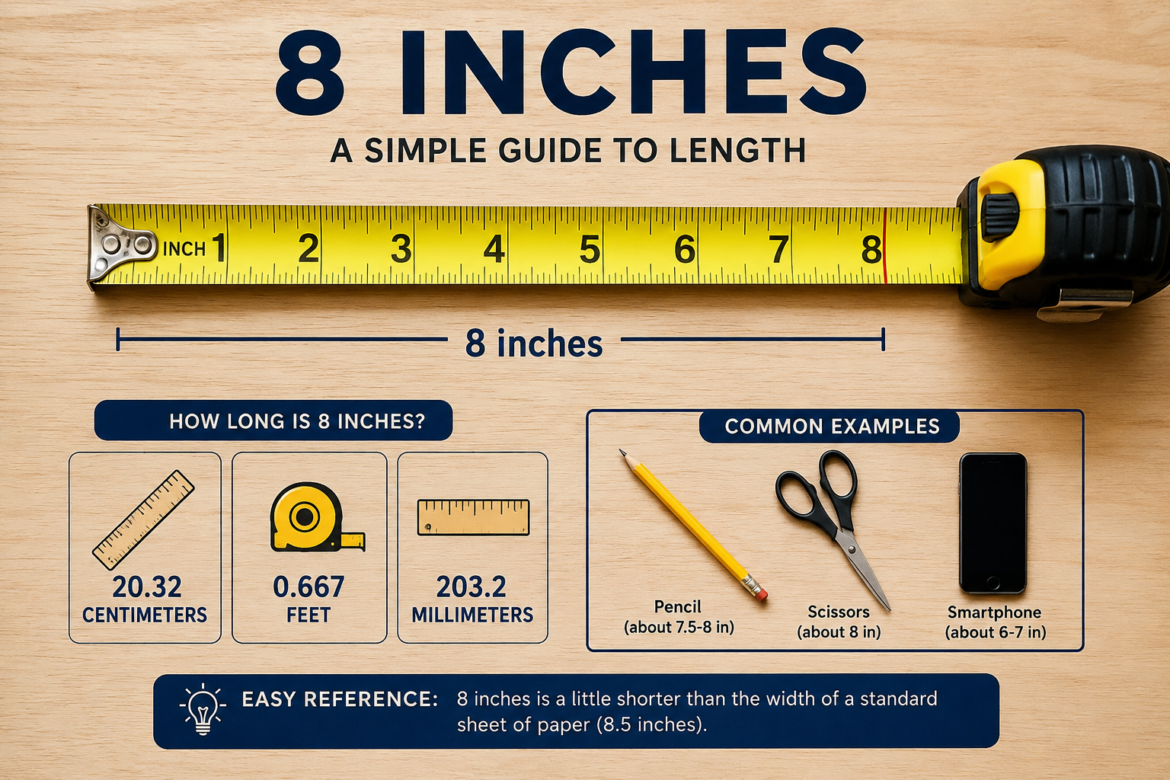
The measurement 8 inches is a common length that appears in everyday life, education, construction, crafts, fashion, cooking, technology, and many other areas. Although eight inches may sound like a simple measurement, understanding exactly how long it is can be useful when estimating dimensions or comparing objects.
An inch is a standard unit of length used primarily in the United States and a few other countries, while centimeters and meters are more commonly used in most parts of the world. Knowing how to visualize 8 inches can make measurements easier when you do not have a ruler immediately available.
How Long Is 8 Inches?
Eight inches is equal to approximately 20.32 centimeters. It is also equal to two-thirds of a foot because one foot contains 12 inches. When thinking about 8 inches visually, imagine a standard ruler and measure from the zero mark to the 8-inch mark. This gives you a practical reference for the length.
The measurement is long enough to represent many everyday objects but short enough to fit comfortably in one hand. Having a familiar mental image of 8 inches can be particularly helpful when shopping online, planning a craft project, measuring furniture components, or following instructions that use imperial measurements.
8 Inches in Centimeters
One of the most common conversions involving 8 inches is converting it into centimeters. Since one inch equals 2.54 centimeters, multiplying 8 by 2.54 gives 20.32 centimeters. This means an item described as 8 inches long would measure 20.32 centimeters under the metric system.
The conversion is exact because the international definition of the inch is fixed at 2.54 centimeters. For quick everyday estimates, you might simply think of 8 inches as roughly 20 centimeters, although the precise value is 20.32 centimeters.
8 Inches in Feet
Converting 8 inches to feet is also straightforward. Because there are 12 inches in one foot, 8 inches represents two-thirds of a foot, or approximately 0.667 feet. This conversion can be useful for home improvement projects, woodworking, interior measurements, and other situations where dimensions may be listed in feet and inches.
For example, a board measuring 8 inches is shorter than one foot by 4 inches. Understanding this relationship makes it easier to compare measurements without needing to perform complicated calculations.
Visualizing 8 Inches Without a Ruler
Being able to visualize 8 inches can be surprisingly useful. A standard sheet of U.S. letter paper is 8.5 inches wide, so 8 inches is just slightly shorter than that width. This provides one convenient mental reference. Another way to imagine the measurement is to picture a ruler and consider the distance between its beginning and the 8-inch mark.
A person’s hand can also provide a rough reference, although hand sizes vary considerably. For accurate work, however, a ruler or measuring tape is always preferable to estimating with body parts or familiar objects.
Everyday Objects That Can Be Around 8 Inches
Many everyday objects have dimensions close to 8 inches. Small notebooks, certain kitchen utensils, tablet accessories, picture frames, decorative items, and some electronic devices can have lengths or widths around this measurement. A typical dinner plate may have a diameter considerably larger than 8 inches, while a small dessert plate may be closer to that range.
Some books are around 8 inches tall, depending on their format. These examples are useful for visualization, but exact dimensions vary by manufacturer and product type, so an object should not be assumed to measure exactly 8 inches simply because it looks similar.
Why 8 Inches Matters in Measurement
Measurements such as 8 inches are important because accurate dimensions help people create, purchase, install, and organize physical objects correctly. A difference of even a few inches can matter when working with limited space. For example, an item that is 8 inches wide may fit comfortably on a shelf where a 10-inch object would not.
In construction and woodworking, a few inches can affect how pieces fit together. In crafts, measurements determine whether patterns and materials align properly. This makes basic knowledge of measurements valuable even in situations that do not initially seem technical.
8 Inches in Home Improvement
Home improvement is one area where 8-inch measurements frequently appear. Shelves, brackets, trim pieces, tiles, hardware, and other components may have dimensions expressed in inches. Someone installing a shelf might need to know whether an 8-inch-deep board will provide enough room for the intended items.
Similarly, an 8-inch measurement can help when determining spacing between fixtures or planning the placement of decorative elements. Accurate measuring is especially important before purchasing materials because returning incorrectly sized items can waste both time and money.
8 Inches in Cooking and Kitchen Measurements
Although cooking is often associated with cups, tablespoons, and teaspoons, inches can also be useful in the kitchen. Baking pans, pizza sizes, cutting boards, knives, and serving dishes may have dimensions listed in inches. An 8-inch cake pan, for example, describes the diameter of the pan and is a common size for certain recipes.
Understanding what 8 inches means can help cooks select the right equipment and understand recipe instructions more effectively. It is important to distinguish between length, width, depth, and diameter because an 8-inch measurement can describe different dimensions depending on the object.
8 Inches in Fashion and Clothing
In fashion, inches are commonly used for measurements involving garments, accessories, and patterns. An 8-inch measurement might describe part of a sleeve, inseam, hem, strap, cuff, pocket, or other component. However, clothing measurements should always be interpreted in context because the same number can represent different dimensions.
An 8-inch measurement on a garment pattern does not necessarily mean the garment itself will have an 8-inch overall size. Fabric stretch, seam allowances, garment construction, and body proportions can all influence the final fit.
8 Inches in Technology and Electronics
Technology products can also be described using dimensions close to 8 inches. Tablets, displays, digital photo frames, and other devices may have screens measured diagonally in inches. An important point is that an “8-inch screen” usually refers to the diagonal distance from one corner of the display to the opposite corner rather than its width.
Consequently, two devices with 8-inch displays can have different widths and heights depending on their aspect ratios and bezels. Understanding how manufacturers describe screen sizes prevents confusion when comparing electronic devices.
How to Convert 8 Inches to Millimeters
The metric system uses millimeters for very small measurements and centimeters for somewhat larger ones. Since one inch equals 25.4 millimeters, 8 inches equals 203.2 millimeters.
This conversion can be particularly useful for engineering, manufacturing, technical drawings, and product specifications. When precision matters, retaining the decimal value is better than rounding it to 203 millimeters because the difference can become relevant in tightly controlled applications.
How to Measure 8 Inches Accurately
The simplest way to measure 8 inches is with a ruler or measuring tape that includes inch markings. Place the starting edge at the zero point and extend the measuring tool to the 8-inch mark. Avoid beginning at the physical edge of a ruler if the ruler’s end is worn or damaged, because this can introduce errors.
For curved or flexible objects, a flexible measuring tape may provide better results. When measuring materials for construction or crafts, double-checking the measurement before cutting is a good habit.
Common Mistakes When Measuring 8 Inches
One common measurement mistake is confusing the starting point. Measurements should normally begin at zero rather than at the ruler’s first numbered marking if the ruler is designed that way. Another mistake is reading the wrong side of a ruler when inches and centimeters are both displayed.
People may also confuse 8 inches with 8 centimeters, even though the two lengths are very different. Eight inches equals 20.32 centimeters, while 8 centimeters equals only about 3.15 inches. Paying attention to the unit is therefore just as important as reading the number.
Why Inches and Centimeters Can Cause Confusion
Inches and centimeters belong to different measurement systems, and their numerical values are not interchangeable. A product labeled 8 inches is much larger than one labeled 8 centimeters. This distinction matters when ordering items online, following international instructions, or comparing product specifications from different countries.
Whenever a measurement seems unusually large or small, checking the unit can prevent an expensive mistake. A quick conversion can also make unfamiliar measurements easier to understand.
8 Inches in International Measurements
The inch is still widely used in certain industries and countries, particularly in the United States. Meanwhile, the metric system is the dominant measurement system internationally. Products sold globally may therefore list both measurements. For example, packaging might describe an item as 8 inches or 20.32 centimeters.
Providing both values helps customers understand the product regardless of which measurement system they normally use. This dual labeling is especially common for electronics, tools, household goods, and manufactured components.
Using 8 Inches for Better Spatial Planning
Knowing the approximate size of 8 inches can help with spatial planning. Suppose you have a narrow shelf and want to determine whether a particular storage container will fit. If the container is 8 inches wide, knowing the shelf’s dimensions beforehand can help you avoid unnecessary purchases.
The same principle applies to desks, cabinets, drawers, wall decorations, and storage areas. Measuring available space first and comparing it with the product dimensions is usually more reliable than judging size from photographs.
How 8 Inches Can Be Explained to Children
Children learning measurements can understand 8 inches more easily when the concept is connected to familiar objects. A ruler is an obvious teaching tool, but educators can also compare 8 inches with everyday items and then check the estimates using a measuring device.
Activities such as drawing an 8-inch line, cutting an 8-inch piece of paper, or arranging objects by length can make measurement more engaging. The goal is to help children understand that numbers represent physical distances rather than simply memorizing conversion formulas.
Final Thoughts on 8 Inches
Understanding 8 inches is more useful than simply knowing the number. It provides a practical reference for comparing objects, converting between measurement systems, planning spaces, completing DIY projects, selecting household products, and interpreting technical specifications. Eight inches equals 20.32 centimeters, 203.2 millimeters, and two-thirds of a foot.
Once you become familiar with this length, it becomes easier to visualize without constantly reaching for a ruler. Whether you encounter the measurement in a recipe, product description, craft project, construction plan, or educational exercise, knowing what 8 inches represents can make everyday measurements much easier to understand.
You Many Also Read: Anne Steves
1 thought on “Understanding 8 Inches: A Simple Guide to Length and Measurement”