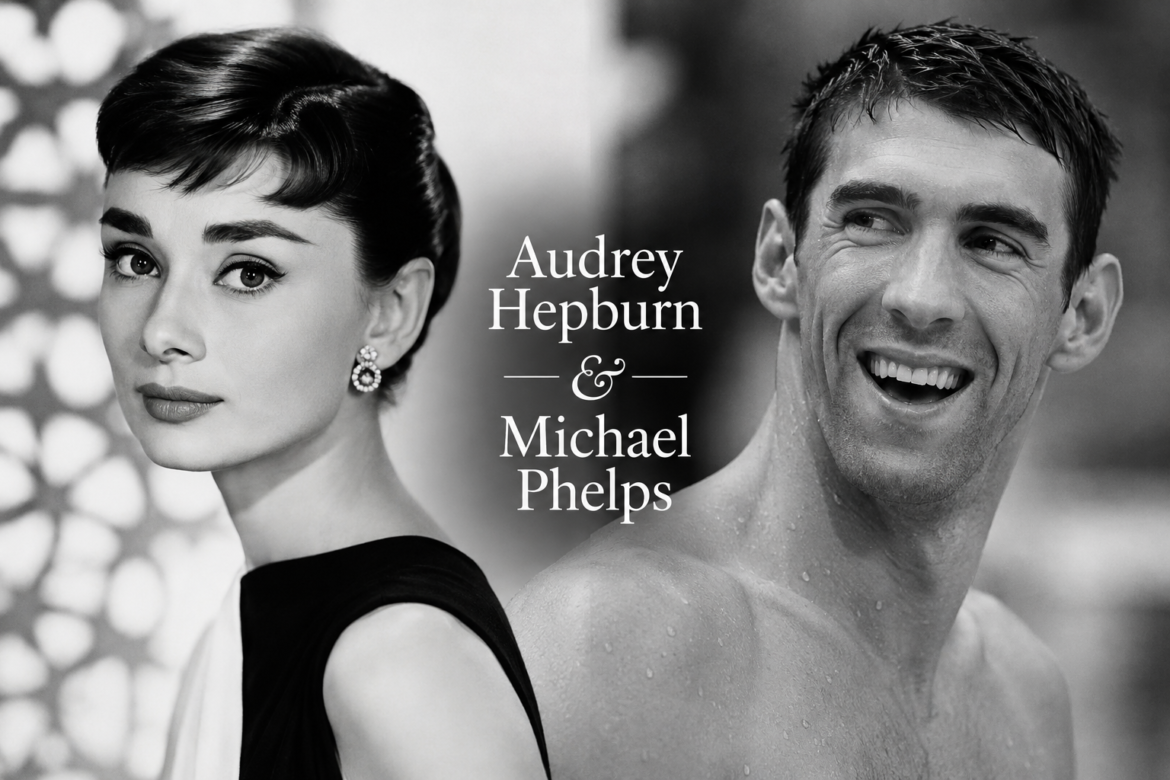
Audrey Hepburn and Michael Phelps: Two Icons from Completely Different Worlds
Audrey Hepburn and Michael Phelps are names that represent extraordinary achievement, but they became famous in remarkably different fields. Hepburn was one of the most admired actresses, fashion figures, and humanitarian personalities of the twentieth century, while Phelps became the most decorated Olympic swimmer in history. At first glance, there seems to be little connection between the elegant Hollywood star and the record-breaking American athlete.
One was celebrated for films, style, and humanitarian work, while the other transformed competitive swimming through discipline, physical ability, and an unmatched collection of Olympic medals. Yet, when their lives and careers are examined together, interesting similarities emerge. Both Audrey Hepburn and Michael Phelps became global symbols of excellence, developed highly recognizable public identities, and demonstrated how dedication can turn exceptional talent into an enduring legacy.
Who Was Audrey Hepburn?
Audrey Hepburn was born on May 4, 1929, in Brussels, Belgium, and grew into one of the most recognizable actresses of Hollywood’s golden era. Her career became especially prominent during the 1950s and 1960s, when she appeared in a series of films that established her as both a serious performer and a fashion icon.
Hepburn possessed a distinctive screen presence that combined elegance, intelligence, humor, vulnerability, and emotional depth. Rather than relying solely on conventional glamour, she developed a style that felt sophisticated yet approachable. Her performances helped make films such as Roman Holiday, Breakfast at Tiffany’s, Sabrina, and My Fair Lady enduring parts of popular culture.
Who Is Michael Phelps?
Michael Phelps was born on June 30, 1985, in Baltimore, Maryland, and became one of the most successful athletes in Olympic history. His swimming career began at a young age, and his exceptional talent quickly became evident. Phelps competed internationally as a teenager and eventually became a dominant force across multiple swimming events.
His greatest Olympic achievements came through several Games, where he accumulated a record 28 Olympic medals, including 23 gold medals. His success was not based simply on natural talent. Years of demanding training, technical refinement, strategic preparation, and extraordinary commitment allowed him to maintain elite performance across multiple Olympic cycles.
Audrey Hepburn and Michael Phelps Represent Different Forms of Excellence
The phrase “Audrey Hepburn and Michael Phelps” brings together two people whose achievements belong to completely different categories. Hepburn’s excellence was primarily artistic and cultural, whereas Phelps’s was athletic and competitive. Hepburn communicated through acting, facial expression, dialogue, movement, and character development. Phelps communicated his excellence through speed, endurance, technique, and competition.
Their accomplishments therefore cannot be measured by the same traditional standards. One collected iconic film performances and international recognition, while the other collected Olympic medals and world records. Nevertheless, both demonstrated an important principle: exceptional achievement often requires years of preparation behind the scenes before the public sees the finished result.
The Early Life of Audrey Hepburn
Hepburn’s childhood was shaped by difficult circumstances, particularly during World War II. She spent part of her youth in the Netherlands during the German occupation. The experience influenced her profoundly and later contributed to her understanding of hardship and humanitarian concerns. As a young woman, she initially pursued ballet and hoped to become a professional dancer.
Although her ambitions in dance were affected by circumstances including her physical development and the challenges of the postwar period, performance remained central to her life. Her transition into acting eventually opened the door to an international career. Her early experiences helped shape the sensitivity and emotional quality that audiences later recognized in her performances.
The Early Development of Michael Phelps
Michael Phelps also demonstrated exceptional ability at a young age. He entered competitive swimming as a child and progressed rapidly through the sport. His long reach, body structure, flexibility, and powerful technique contributed to his potential, but physical advantages alone could not explain his success.
Swimming at the highest level requires thousands of hours of repetitive training, careful attention to technique, mental preparation, and the ability to perform under immense pressure. Phelps’s early rise showed that he possessed both extraordinary physical talent and the willingness to develop that talent through rigorous preparation.
Audrey Hepburn’s Breakthrough in Hollywood
Hepburn’s international breakthrough came with Roman Holiday, released in 1953. Her performance as Princess Ann earned her widespread acclaim and an Academy Award for Best Actress. The film established her as a major Hollywood star and introduced audiences to the qualities that would define her public image.
She did not fit neatly into the established mold of glamorous movie stars. Instead, she brought a graceful, modern, and youthful personality to the screen. Her success in Roman Holiday was followed by major roles in films that further strengthened her reputation. Over time, she became associated not only with successful movies but also with a particular idea of timeless elegance.
Michael Phelps’s Rise to Olympic Stardom
Phelps’s Olympic career began at the 2000 Sydney Games when he was only 15 years old. Although he did not win a medal at those Games, his participation marked the beginning of an extraordinary Olympic journey. Four years later at Athens, he won six gold medals and two bronze medals, announcing himself as one of the world’s greatest swimmers.
His performance in Athens was followed by even greater success at Beijing in 2008, where he won eight gold medals. That achievement made him one of the central figures of the Games and cemented his reputation as an extraordinary Olympic competitor.
The Importance of Discipline in Both Careers
One of the strongest similarities between Audrey Hepburn and Michael Phelps is the importance of discipline. Hepburn’s graceful performances could appear effortless to viewers, but acting at a high level required preparation, rehearsal, memorization, emotional control, and professional consistency. Her work also involved adapting to different directors, characters, scripts, and production environments. Phelps’s achievements were even more visibly connected to repetitive discipline.
Swimming requires athletes to perform the same movements thousands of times while constantly searching for tiny improvements. His training regimen was famously demanding, and his ability to repeatedly prepare for major competitions became an essential part of his success.
Two Global Images That Became Larger Than Their Professions
Audrey Hepburn eventually became more than an actress. Her name became associated with fashion, elegance, classic cinema, and humanitarian work. Photographs of her continue to appear in fashion discussions decades after her most famous films were released. Michael Phelps similarly became more than a swimmer.
His name became closely connected with Olympic excellence, competitive swimming, determination, and athletic achievement. Their professions created the foundation for their fame, but their public identities grew beyond their original fields. This is one reason why both remain recognizable to people who may not have followed their careers closely.
Audrey Hepburn as a Fashion Icon
Hepburn’s influence on fashion is one of the most enduring aspects of her legacy. Her partnership with designer Hubert de Givenchy helped create a visual identity that continues to influence fashion. Her clothing choices often emphasized simplicity, clean lines, elegance, and sophistication. Instead of depending on excessive decoration, Hepburn frequently demonstrated how understated clothing could create a powerful image.
Her appearance in Breakfast at Tiffany’s became especially influential, with her character Holly Golightly becoming one of the most recognizable figures in cinematic fashion. Her style continues to inspire designers, photographers, and audiences around the world.
Michael Phelps and the Image of an Elite Athlete
Phelps created a very different kind of cultural image. His identity became associated with the competitive athlete who pursues tiny advantages relentlessly. Swimming is a sport in which fractions of a second can determine victory, making technique and preparation particularly important.
His performances helped increase public attention toward competitive swimming, especially during Olympic years. The image of Phelps standing on the starting block, preparing for another race, became a familiar symbol of elite athletic competition. His success demonstrated how a highly specialized sport can produce a globally recognizable personality.
Their Relationship With Public Pressure
Fame brought enormous public attention to both Hepburn and Phelps. Hepburn lived during an era when Hollywood stars were heavily photographed and closely followed by newspapers and magazines. Her appearance became part of her professional identity, creating expectations about how she should look and behave.
Phelps faced a different form of scrutiny as modern sports media expanded. Every race, interview, mistake, and victory could receive international attention. Both therefore had to manage the gap between their private lives and their public identities. Their experiences demonstrate that becoming an international icon can bring opportunities as well as considerable pressure.
Audrey Hepburn’s Humanitarian Legacy
One of the most important chapters of Hepburn’s later life was her work with UNICEF. After spending much of her career in entertainment, she devoted significant energy to humanitarian causes, particularly issues affecting children. She traveled to different countries to draw attention to poverty, hunger, disease, and difficult living conditions.
Her celebrity gave her the ability to attract international attention to problems that might otherwise receive less media coverage. This humanitarian work is an essential part of understanding her legacy because it showed that she wanted her fame to serve a purpose beyond entertainment.
Michael Phelps and His Broader Influence
Phelps has also used his public platform for causes beyond competition. Through the Michael Phelps Foundation and other initiatives, he has been associated with efforts involving swimming, water safety, and youth development. Swimming is not only an Olympic sport but also an important life skill, particularly because learning to swim can help reduce drowning risks.
His continued involvement with swimming-related initiatives has allowed his influence to extend beyond the medals he won during his competitive career. In this way, his legacy increasingly includes what he has contributed to the sport and to younger generations.
What Makes Audrey Hepburn and Michael Phelps Interesting Together?
The interest in Audrey Hepburn and Michael Phelps comes largely from the contrast between them. They belong to different generations and professions and achieved fame under very different circumstances. Hepburn became famous through cinema and fashion during the twentieth century, while Phelps became famous through international sports competition in the twenty-first century.
Yet both became instantly recognizable names. Their stories show how global icons can emerge from completely different areas of human achievement. Comparing them is therefore less about finding a direct personal connection and more about understanding the common qualities that can make a person culturally significant.
Their Shared Commitment to Excellence
Hepburn and Phelps both illustrate the difference between talent and mastery. Talent can create an opportunity, but long-term excellence generally requires commitment. Hepburn’s career involved learning different characters and working within demanding film productions. Phelps had to spend years developing his swimming technique and conditioning.
Both faced setbacks and changing circumstances throughout their lives. Their achievements suggest that excellence is not one dramatic moment but the result of many smaller decisions repeated over time. This idea helps explain why their legacies have remained relevant long after individual performances or films have passed from current popularity.
The Role of Reinvention in Their Legacies
Another similarity is reinvention. Hepburn began as a performer with ambitions connected to ballet before becoming an internationally celebrated actress and later a humanitarian. Each stage added another dimension to her public identity. Phelps similarly evolved from a young swimming prodigy into a multiple Olympic champion and eventually a public figure involved in initiatives beyond competitive swimming.
Reinvention can help public figures remain meaningful because it allows their identities to develop rather than remain tied to one achievement. Both Hepburn and Phelps demonstrate how a person’s legacy can grow through different chapters of life.
How Their Legacies Continue Today
The continuing popularity of Audrey Hepburn is evident in the repeated interest in her films, photographs, fashion influence, and humanitarian work. New generations continue discovering her through classic movies and cultural references. Michael Phelps’s achievements remain a benchmark in Olympic swimming, and his name is regularly discussed whenever exceptional athletic accomplishments are considered.
Their legacies survive because they achieved something difficult to replicate: they became symbols of excellence within their respective fields. Even people who know little about their complete careers often recognize their names immediately.
Audrey Hepburn and Michael Phelps as Inspirational Figures
Although their careers were dramatically different, both figures can inspire people who are pursuing their own goals. Hepburn’s story emphasizes creativity, resilience, elegance, adaptability, and service. Phelps’s story emphasizes preparation, consistency, competitive focus, and perseverance. Their lives remind audiences that success can take different forms.
Not everyone needs to become a world-famous actor or Olympic champion to demonstrate excellence. The deeper lesson is that meaningful achievement comes from developing one’s abilities and using opportunities responsibly.
Why Their Names Remain Searchable and Relevant
The keyword “Audrey Hepburn and Michael Phelps” combines two highly recognizable names whose stories continue to attract interest. People may encounter the two names together because they are researching famous personalities, cultural icons, inspirational figures, or comparisons between different types of success.
Search interest surrounding major public figures often remains strong because new generations continually discover their stories. Hepburn’s classic films and Phelps’s Olympic records provide lasting reasons for audiences to revisit their careers. Their continued visibility shows that cultural relevance can survive long after the peak of a person’s professional career.
The Difference Between Celebrity and Legacy
Celebrity can be temporary, while legacy has the potential to last for generations. Audrey Hepburn’s fame began in entertainment, but her humanitarian contributions became an important part of how she is remembered. Michael Phelps’s celebrity was initially built around swimming victories, but his broader work and influence have added additional dimensions to his reputation.
Their stories demonstrate that legacy is created through more than publicity. It is shaped by achievements, character, contributions, and the impact a person has on other people. This distinction helps explain why some famous individuals remain culturally important long after their original careers end.
A Lasting Comparison of Two Extraordinary Lives
Audrey Hepburn and Michael Phelps may seem like an unlikely pair, but comparing their lives reveals meaningful similarities. Hepburn transformed herself into a cinematic and cultural icon whose influence extended into fashion and humanitarian work. Phelps transformed extraordinary swimming ability into an Olympic career that established records and created a lasting athletic legacy.
Their accomplishments cannot be measured using the same standards, yet both demonstrate dedication, resilience, preparation, and the ability to inspire audiences beyond their professions. One became a symbol of timeless elegance and compassionate service, while the other became a symbol of athletic excellence and competitive determination.
Conclusion: Audrey Hepburn and Michael Phelps
The stories of Audrey Hepburn and Michael Phelps ultimately demonstrate two very different paths toward global recognition. Hepburn used acting, fashion, and humanitarian service to create an enduring cultural legacy, while Phelps used extraordinary swimming ability, discipline, and Olympic competition to establish himself as one of the greatest athletes ever. Their careers unfolded in different eras and industries, but both showed that lasting influence depends on more than natural talent.
It requires dedication, resilience, personal growth, and the ability to leave something meaningful behind. Audrey Hepburn remains remembered for her timeless presence and humanitarian spirit, while Michael Phelps continues to represent the possibilities of athletic achievement. Together, their stories provide an interesting reminder that greatness can take many forms, and that a truly lasting legacy can reach far beyond the profession in which a person first becomes famous.
You Many Also Read: The Love Hypothesis Movie Cast



1 thought on “Audrey Hepburn and Michael Phelps: From Hollywood to Olympic Greatness”