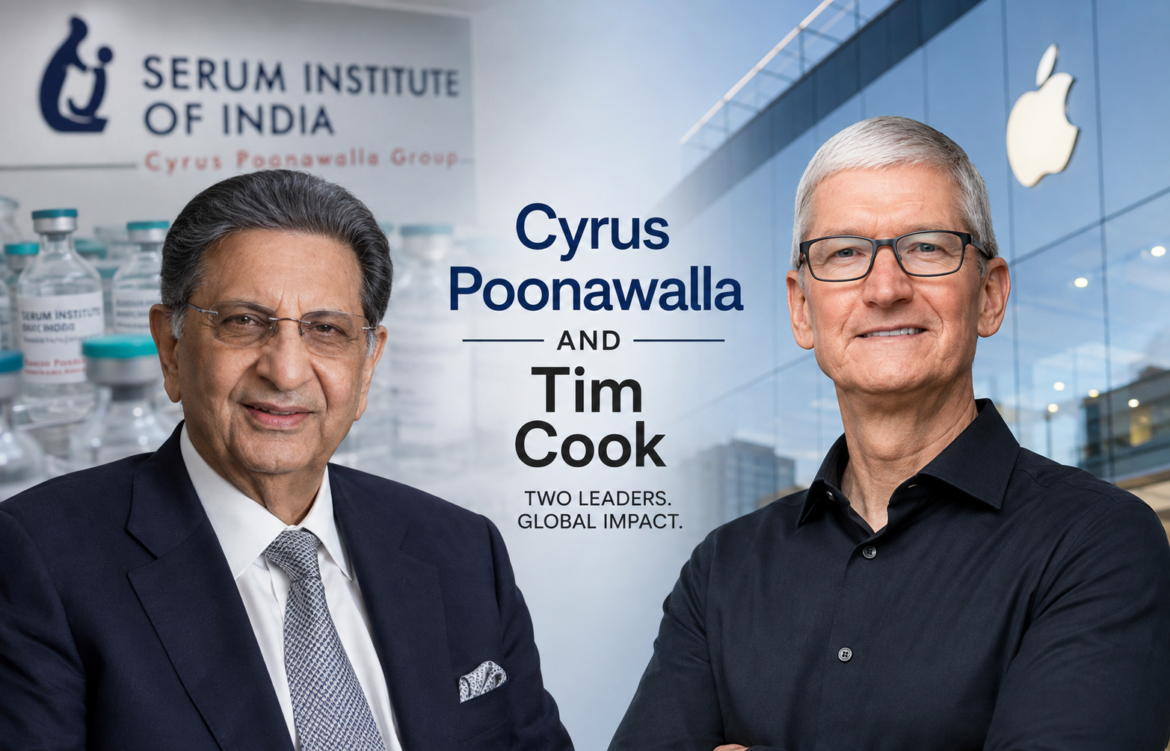
Cyrus Poonawalla and Tim Cook represent two very different but equally influential approaches to leadership, entrepreneurship, and global business. Cyrus Poonawalla is best known as the founder of the Serum Institute of India, a company that became one of the world’s largest vaccine manufacturers by volume.
Tim Cook, meanwhile, is the chief executive officer of Apple, one of the most valuable and recognizable technology companies in the world. Although their industries, backgrounds, and leadership journeys are distinct, both figures have become associated with organizations that operate on a global scale. The keyword “cyrus poonawalla and tim cook” brings together two prominent names whose careers offer an interesting comparison of healthcare manufacturing and consumer technology leadership.
Who Is Cyrus Poonawalla
Cyrus S. Poonawalla is an Indian entrepreneur and business leader who founded the Serum Institute of India in 1966. His original vision was to make life-saving vaccines more affordable and accessible, particularly for populations in developing countries. Over the decades, the organization grew from an ambitious pharmaceutical venture into a major vaccine manufacturer with an international presence.
Poonawalla’s career demonstrates how long-term investment in manufacturing capacity, scientific development, and public health can transform a company into an institution with global importance. His name became especially prominent internationally during the COVID-19 pandemic, when vaccine production and supply became central issues for governments and communities around the world.
Who Is Tim Cook
Tim Cook is an American business executive who became Apple’s CEO in 2011, succeeding Steve Jobs. Before taking the top position, Cook had already played an important role in transforming Apple’s operations and supply chain. His management style has often been associated with operational discipline, global manufacturing coordination, privacy, sustainability, and gradual expansion of Apple’s ecosystem.
Under Cook’s leadership, Apple continued to develop major product categories while also placing greater emphasis on services, wearable devices, health-related technology, and environmental initiatives. His tenure illustrates how effective leadership can involve not only creating products but also managing enormous global systems behind those products.
Different Industries, Similar Global Influence
At first glance, Cyrus Poonawalla and Tim Cook may seem to have little in common. One built a company around vaccines and biotechnology, while the other leads a technology company famous for smartphones, computers, tablets, and digital services. However, their organizations share an important characteristic: both depend on highly sophisticated global supply chains.
Vaccine manufacturing requires scientific expertise, specialized facilities, quality control, raw materials, regulatory approvals, packaging, and distribution. Technology manufacturing similarly requires complex networks of suppliers, assembly facilities, logistics providers, software developers, and retailers. The careers of cyrus poonawalla and tim cook therefore demonstrate the importance of managing large interconnected systems.
Cyrus Poonawalla’s Entrepreneurial Vision
Poonawalla’s entrepreneurial journey began with a long-term objective rather than a short-lived business opportunity. The Serum Institute was created with the idea that vaccines could be manufactured at scale and offered at prices that made them accessible to a much wider population. This approach required substantial investment and patience because pharmaceutical manufacturing involves demanding scientific and regulatory standards.
Over time, the company expanded its capabilities and became a significant supplier of vaccines used in international immunization programs. Poonawalla’s story is therefore closely connected with the concept of affordable healthcare and the role of manufacturing scale in reducing the cost of essential medicines.
Tim Cook’s Rise Through Operations
Tim Cook’s path to Apple’s top position was different from the classic image of a technology founder. Cook was not one of Apple’s original founders, and his career developed through operations, supply-chain management, and executive leadership. He joined Apple in 1998 after holding senior positions at other major companies.
His ability to oversee manufacturing and logistics became particularly valuable to Apple as the company expanded its product portfolio and international reach. When Cook eventually became CEO, he brought an operational mindset to a company that had already established an extraordinary reputation for product design and innovation.
Leadership Styles of Poonawalla and Cook
The leadership styles associated with Cyrus Poonawalla and Tim Cook reflect the demands of their respective industries. Poonawalla’s leadership has been closely connected with entrepreneurship, manufacturing expansion, scientific investment, and healthcare accessibility. Cook’s leadership has emphasized operational execution, product ecosystems, supply-chain resilience, privacy, and corporate responsibility.
Neither career can be understood simply through personality or public appearances. Both demonstrate that leadership at the highest level requires the ability to coordinate people, capital, technology, production, and long-term strategy. Their experiences also show how different leadership approaches can succeed when aligned with an organization’s purpose and competitive environment.
The Importance of Manufacturing
Manufacturing is one of the strongest connections between the worlds of Poonawalla and Cook. The Serum Institute became famous for producing vaccines on an enormous scale, while Apple became famous for coordinating a worldwide production network capable of delivering millions of sophisticated electronic devices.
In both cases, manufacturing is more than simply assembling a product. It involves forecasting demand, managing suppliers, maintaining quality, controlling costs, meeting regulatory or technical requirements, and delivering products efficiently. Their careers highlight how manufacturing excellence can become a major source of competitive advantage.
Cyrus Poonawalla and Global Public Health
Poonawalla’s significance increased dramatically as global attention focused on vaccine access. The Serum Institute’s manufacturing capacity positioned it as an important participant in international vaccine supply. The COVID-19 pandemic made the importance of large-scale vaccine production particularly visible because governments and health organizations needed enormous quantities within a relatively short period.
Poonawalla’s business therefore became part of a much larger conversation about public health, manufacturing capacity, international cooperation, and equitable access to medical products. His career illustrates how a private company can have consequences that extend far beyond ordinary commercial activity.
Tim Cook and the Expansion of Apple
Tim Cook’s leadership at Apple has involved managing a company whose influence extends across hardware, software, services, entertainment, payments, communications, and digital ecosystems. During his tenure, Apple continued to develop the iPhone while expanding products such as the Apple Watch and AirPods and growing services such as subscriptions and digital platforms.
Cook also oversaw Apple during periods of rapid changes in consumer technology and global supply-chain conditions. His challenge has been to preserve the strengths of an established technology giant while continuing to find opportunities for growth.
Technology and Healthcare as Global Forces
The comparison between Cyrus Poonawalla and Tim Cook becomes especially interesting when viewed through the broader influence of technology and healthcare. Healthcare companies can directly affect life expectancy and disease prevention, while technology companies influence communication, productivity, entertainment, and everyday behavior.
The Serum Institute’s work demonstrates the societal importance of medical manufacturing, whereas Apple demonstrates the cultural and economic influence of consumer technology. Both sectors require constant investment in research, infrastructure, talent, and international operations. As a result, the leaders of major organizations in these fields carry responsibilities that go beyond conventional business performance.
The Role of Innovation in Their Careers
Innovation does not always mean inventing something completely new. In Poonawalla’s case, innovation can be understood through the ability to manufacture vaccines efficiently at enormous scale and make them more accessible. In Cook’s case, innovation has included refining products, developing services, integrating hardware and software, and improving the systems that support Apple’s ecosystem.
Both approaches demonstrate that innovation can involve processes, manufacturing, distribution, and business models as well as physical products. Their careers offer different examples of how organizations can use innovation to create long-term impact.
Global Supply Chains and Business Resilience
One of the most important lessons from both leaders is the significance of resilient supply chains. Pharmaceutical manufacturers depend on specialized ingredients, equipment, packaging, testing, and distribution networks. Technology manufacturers depend on semiconductors, displays, batteries, processors, rare materials, assembly partners, and transportation systems.
Disruptions can affect production and customers around the world. Leaders such as Poonawalla and Cook therefore operate in environments where supply-chain decisions can influence not only financial performance but also the availability of important products. Their experiences demonstrate why modern businesses increasingly prioritize flexibility, diversification, and long-term supplier relationships.
Cyrus Poonawalla’s Business Legacy
Poonawalla’s business legacy is closely associated with the transformation of the Serum Institute into a major global vaccine producer. The company’s development shows how a relatively focused manufacturing business can become an internationally significant organization when it combines scale with scientific capabilities.
Poonawalla’s entrepreneurial approach also demonstrates the importance of investing in sectors where long-term demand is supported by fundamental human needs. Vaccination remains an essential component of modern public health, giving the company’s work relevance well beyond individual markets.
Tim Cook’s Corporate Legacy
Tim Cook’s corporate legacy is still developing, but his leadership has already shaped Apple during one of the most important periods in its history. He successfully transitioned the company after the death of Steve Jobs while maintaining Apple’s strong brand identity.
Under Cook, Apple expanded its services business, strengthened its wearable technology portfolio, emphasized privacy, and increased its attention to environmental and social issues. His leadership illustrates the challenge of guiding a mature global company where expectations are extremely high and even small strategic decisions can affect millions of customers.
Business Philosophy and Long-Term Thinking
Long-term thinking is another useful point of comparison between Poonawalla and Cook. Pharmaceutical manufacturing requires years of investment because new facilities, technologies, and products cannot be developed instantly. Technology companies likewise need long-term planning because hardware development, software platforms, supply chains, and research programs involve substantial resources.
Both leaders demonstrate the value of thinking beyond immediate results. Sustainable growth often depends on decisions made years before their benefits become visible. This principle is particularly relevant for companies operating at global scale.
Challenges Faced by Cyrus Poonawalla
Leading a major vaccine manufacturer comes with significant challenges. Pharmaceutical companies must meet strict quality requirements and navigate regulatory systems in multiple countries. Production must remain reliable because healthcare providers and governments depend on consistent supplies.
Companies also face scientific uncertainty, changing disease patterns, pricing pressures, and intense competition. During major health emergencies, expectations can become even greater because demand may increase suddenly. Poonawalla’s career shows how pharmaceutical entrepreneurship requires not only commercial knowledge but also an understanding of science, regulation, manufacturing, and public health.
Challenges Faced by Tim Cook
Cook faces a different set of pressures. Apple operates in an intensely competitive technology industry where consumer expectations change rapidly. The company must continually develop compelling products while protecting its ecosystem and managing enormous production networks.
Apple also faces regulatory scrutiny in different markets, changing consumer spending patterns, geopolitical risks, and competition from companies across smartphones, computers, artificial intelligence, cloud services, and digital platforms. Maintaining growth at Apple’s scale is itself a major leadership challenge. Cook’s role requires balancing innovation with reliability and short-term performance with long-term strategic planning.
What Their Stories Teach Entrepreneurs
The careers of Cyrus Poonawalla and Tim Cook offer several lessons for entrepreneurs and business students. First, specialization can become powerful when supported by long-term investment. Second, operational excellence can be just as important as a compelling idea. Third, global companies need strong systems rather than dependence on individual decisions.
Finally, businesses can create wider influence when their products or services address significant needs. Poonawalla’s focus on vaccines and Cook’s leadership of technology products show that successful organizations can emerge from very different industries while sharing fundamental principles of disciplined execution.
The Broader Meaning of Cyrus Poonawalla and Tim Cook
The keyword “cyrus poonawalla and tim cook” connects two business figures who symbolize different dimensions of modern global enterprise. Poonawalla represents pharmaceutical entrepreneurship, vaccine manufacturing, and the expansion of affordable healthcare products.
Cook represents technology leadership, operational excellence, consumer products, and the evolution of a global digital ecosystem. Their paths are not identical, but that is precisely what makes the comparison valuable. Studying them together provides a broader understanding of how leadership operates across industries that have enormous economic and social influence.
Conclusion: Two Distinct Paths to Global Leadership
Cyrus Poonawalla and Tim Cook have built their reputations in very different environments, yet their careers reveal several common themes: long-term thinking, operational discipline, global scale, innovation, and the ability to manage complex organizations. Poonawalla’s association with vaccine manufacturing highlights the importance of healthcare infrastructure and accessible medical products, while Cook’s leadership at Apple demonstrates the power of technology, supply-chain management, and ecosystem development.
Neither story is simply about personal success. Both demonstrate how business leadership can influence industries, consumers, and communities on a global level. Looking at Cyrus Poonawalla and Tim Cook together provides an engaging way to understand how two leaders from different sectors have navigated complexity and helped shape the modern business landscape.
You Many Also Read: Deez Nuts Jokes



1 thought on “Cyrus Poonawalla and Tim Cook: Two Leaders, Two Remarkable Success Stories”